


Conversation


Growth Newsletter #349
Hey Friends,
One of the most common (and demoralizing) growth problems we see founders run into? Watching their product lose to a worse one. Not a cheaper one or a better-funded one. Somehow they’re just losing customers to an inferior competitor.
Truth is, the company that wins is often the one that explains its value best. The one with the better story.
That's the work we do through Story Systems: a complete messaging system that fuels your ads, landing pages, funnels, and sales.
If you're losing to worse competition and you don't know why, give us a shout and we'll see if you're a fit.
This week: Devon leads off on the difference between a vitamin and a painkiller, then how one small site picked up more than 500,000 AI citations, and how to end your ads on the emotion you want your readers to keep. Let's dive in.
—Nick
This week's tactics
Vitamins vs painkillers, 500K AI citations, and end your ads on emotion.
01.Positioning
Turn a vitamin into a painkiller
Insight from Devon Reynolds, Strategist at Demand Curve.
It’s one of the biggest questions we work through with our Story Systems clients on positioning.
A vitamin is a nice-to-have. A painkiller is a must-have.
Painkillers address a pain the buyer already feels. In our world, that might be revenue lost or a deadline missed. Your copy only has to prove you’re the fastest way out of something they know is happening.
A vitamin addresses a gradual improvement nobody’s currently suffering without. Your message has to create the sense that a problem exists before it can even ask for the sale. That’s the persuasion step a painkiller gets to skip, and it’s much harder.
That gap shows up again after the sale: a painkiller gets renewed because cutting it causes visible damage, a vitamin gets cut first when budgets tighten, because nothing breaks when it disappears.
So you want to be positioned as the painkiller. And you can be, because vitamin and painkiller describe the buyer’s situation. Same product, different buyer, different answer.
Take any cybersecurity company.
They’re a painkiller for a company that just got breached, or one with a compliance audit next month. That risk is about to cost them a client, a fine, or their reputation.
They’re a vitamin for a company that’s never had an incident and assumes it won’t. Nothing’s on fire, so “better safe than sorry” competes against every other line item that sounds reasonable to defer. So it’s the same product, but one buyer is trying to stop bleeding and the other has to be convinced the risk is real.
If most of your buyers are treating you like a vitamin, here’s a bit of good news: You can turn a vitamin into a painkiller by changing who you talk to, and when.
First, timing. Find the painkiller moment hiding inside it. Almost no product is a pure vitamin for everyone. There’s usually a trigger where your product’s absence suddenly causes real, felt pain: a missed deadline, a failed audit, a new hire drowning during onboarding. Market to that moment instead of the general ongoing benefit, and the same product starts behaving like a painkiller for whoever just hit that trigger.
Then, seniority. Sell to whoever in the org actually feels a real cost, even if the end user doesn’t. An employee might see a tool as nice-to-have, while their manager sees the turnover, rework, and lost hours it prevents as a real number on a budget. Find the buyer one level up who actually needs a painkiller.
So: who are you already a painkiller for?
02.AI search
How to get AI citations where legacy sites fall short
Insight from Nelson Isibor, via Saturation, our AI search company.
Here's a tactic for getting cited by LLMs:
Find a category where the authoritative source has real trust but a bad UX.
Think .gov, .edu, legacy media. These pages rank because of what they are, and they’re often slow, outdated, and badly structured. So people search, land there, don’t get an answer, and go looking for someone who explains it in plain English.
You can create content for that person.
Map every real query around that pain point from forums, personal experience, and search data. Then build free tools that solve the specific friction (a checklist, a generator, a finder) rather than just articles. Solve what that person is searching for.
You won’t take position 1 on the incumbent’s own branded queries, and you don’t need it. You might take positions 4 through 9 and get some real traffic. But that’s not what this is about. The real benefit comes from the AI citations.
AI answer engines had the exact same problem finding a good source that humans did. They ground their responses in whatever source is easiest to retrieve and parse. A .gov page has the authority signal, so it gets pulled in. But if it’s thin or badly structured, the grounding step still needs a cleaner source to actually construct the answer from. That’s the opening your page fills.
Nelson gave this a shot against a .gov domain. The results?
Over six months that site took 32,800 Bing clicks and 13,200 Google clicks. It also picked up over 500,000 citations in Bing’s AI answers. ChatGPT alone sent more users than Yahoo and DuckDuckGo combined. And the queries pulling AI citations matched the queries pulling human clicks almost exactly.
Two conditions before you try it. The incumbent has to be bad at serving the query, not just a competitive niche. And this approach needs patience: there were four flat months before the growth curve kicked in, so it’s not a fit for anyone needing fast results.
Nelson calls this gap arbitrage: official authority, poor information experience, unresolved user intent, and whoever fills the gap collects the search visibility and the citations.
03.Copywriting
End your ads on the emotion you want your readers to walk away with
Insight from Nick Costelloe, Content Lead at Demand Curve.
You might've seen this ad from Patagonia at some point.
We've written about it before. I came across it again recently and noticed something I'd missed. Then this post took off on LinkedIn.
Regardless of what you think of Patagonia, this is world-class copywriting.
Read it first. Then read it backwards.
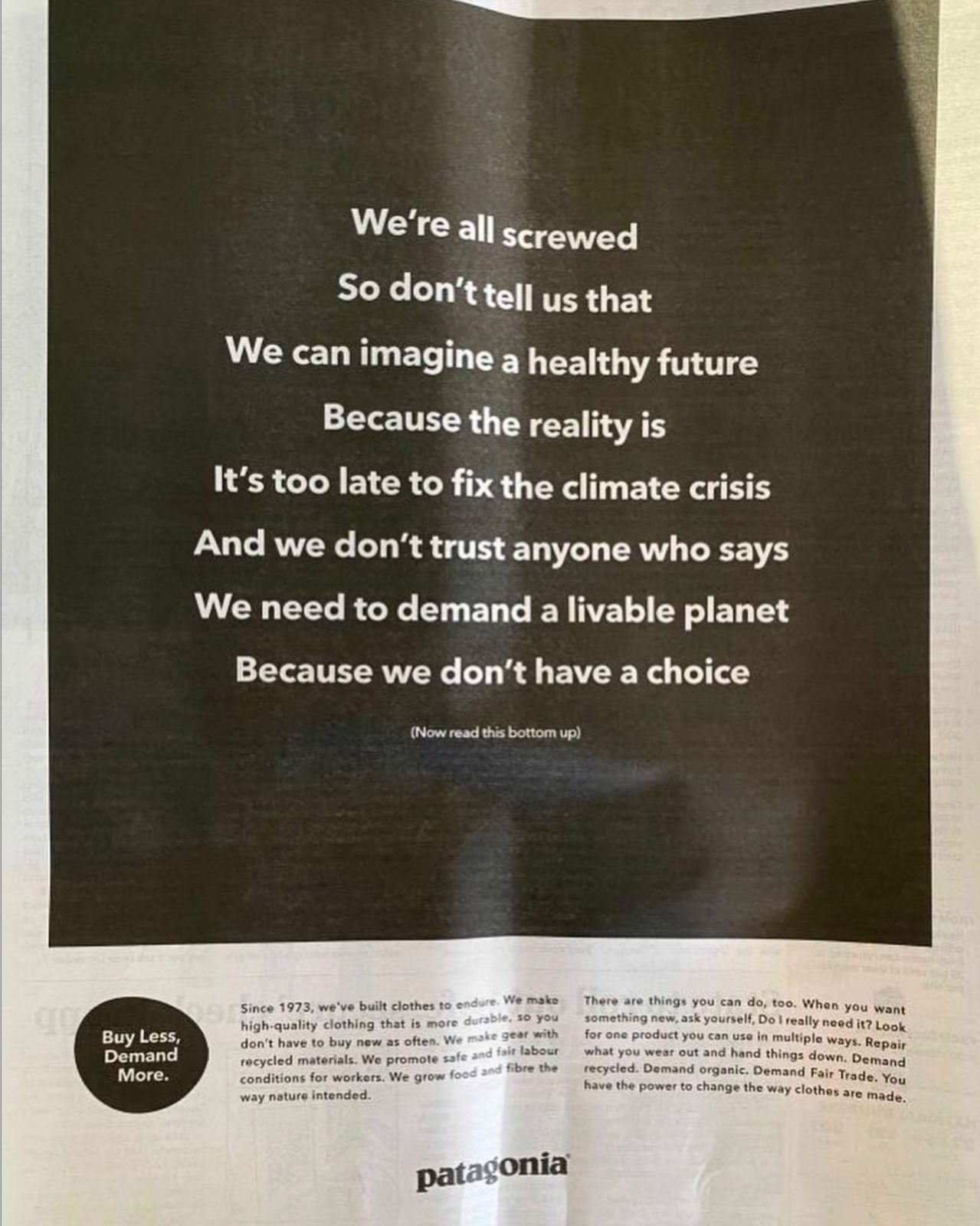
All good copy leans on power words: the persuasive, descriptive ones that make you feel something instead of just understand something. That’s not what’s novel here.
What’s remarkable is that the same words tap into different emotions depending on which way you read them. Top down it’s anger and fear. Bottom up it’s hope.
What I noticed this time is that the feeling you leave with is the one that drives action. The ad is built so you go down first and hit the despair, then climb back up and land on hope. Pessimist turned optimist. That last feeling is what sticks to the brand.
The usual lesson is appeal to your readers’ emotions. That’s table stakes. The more useful lesson is that sequence decides which emotion they walk away with. We justify with logic, but emotion drives what we actually do: share things, donate to causes, buy what we buy. And for Patagonia, a brand that built its entire reputation on sustainability, hope is a huge reason why we buy.
And yeah, “Buy Less, Demand More” is refreshing as hell. A retailer telling you to buy less of their stuff. Same move they made with “Don’t Buy This Jacket” back in 2011, a $57,000 newspaper page their CEO later valued at $40–50 million in earned coverage.
So when you’re writing copy, think about the feeling you want your reader to end with. That’s what they’ll feel when they think of your brand.
Community Spotlight
News and Links
Something fun
.avif)
If you enjoyed this, please consider sharing with a friend. If a friend sent you this, get the next newsletter by signing up here.
Who's Demand Curve?
We’re on a mission to make starting, building, and growing startups easier.
We share high-quality, vetted, and actionable growth content as we learn it from the top 1% of marketers. We democratize senior growth knowledge.
How we can help you grow:
- 📖 Read our free playbooks, articles, growth guide, and teardowns—we break down the strategies & tactics used by fast-growing startups.
- 🚀 Running growth yourself? Use our updated Growth Program to get traction and build your growth engine.
- 📈 Need help with ads? We’ve built the ads agency for startups.
- 🌏 Looking to hire overseas growth talent? Our partner, GrowthPair, will find you an expert for 40-80% lower costs.
- 📣 Get in front of 90,000+ founders by sponsoring this newsletter.
— Thanks y'all!






The Newsletter Vault
Only available to Members. Enroll now to get access to the full catalogue of Demand Curve's newsletters.
More newsletter editions
Join 91,000 founders and marketers getting actionable startup growth tactics in their inbox each week.


