


Conversation


The Tactics Vault
Each week we spend hours researching the best startup growth tactics.
We share the insights in our newsletter with 90,000 founders and marketers. Here's all of them.


Narrow to grow, take-back pricing, change the axis.
01.Messaging
Narrowing your market can actually grow it
Insight from Devon Reynolds, Growth Strategist at Demand Curve.
Most startups are reluctant to narrow their positioning.
They’re worried about turning away potential customers. So they write messaging that appeals to everyone.
The problem is that, in most cases, broad messaging doesn’t give anyone a good reason to pay attention.
Consider two headlines for a hypothetical AI product:
Option A: “Use AI to grow your business.”
Option B: “Turn more of your SaaS demo requests into paying customers.”
The first could apply to millions of businesses. But it doesn’t tell any of them much about what the product actually does.
The second speaks to a smaller group, but those people immediately understand what problem the product solves and why they might want it.
That’s the difference between reaching a large audience and being relevant to one.
A few ways to make your positioning more specific:
- Focus on a particular customer. Instead of “marketing software for businesses,” try “marketing software for independent accounting firms.”
- Focus on a particular problem. Instead of “improve your sales process,” try “stop losing qualified leads between the demo and the proposal.”
- Focus on a particular situation. Instead of “helping startups grow,” try “helping SaaS founders find their first repeatable acquisition channel.”
Here’s an exercise we do with all of our Story Systems clients.
Show your homepage headline to someone unfamiliar with your business, then ask them three questions:
- Who is this product for?
- What problem does it solve?
- Why would someone choose it over the alternatives?
If they can’t answer all three clearly and quickly, your positioning needs work.
And if you’re worried about narrowing your audience too much, remember that your positioning isn’t permanent. You can start with the customers most likely to buy, establish a foothold, and expand from there.
02.Positioning
Change the axis you’re competing on
Insight from Nick Costelloe, Content Lead at Demand Curve.
One of my favorite things to do is study big, established companies.
But I don’t care much about what they’re doing now. They’re already big, and most of them grow (or fail) despite what their marketing teams do.
I care about what they did in their early days. The stuff that actually got them traction.
So let’s talk about the cycling brand Rapha. Everyone’s dunking on them right now for nine straight years of losses.
But they built a £200 million brand selling wool jerseys and... pain? And there’s an early positioning lesson in here worth learning.
Look at the photo below:

In 2004, every cycling brand was selling the same thing: speed.
Lighter, faster, tighter. Neon kit covered in sponsor logos, the same kit your favorite pro raced the Tour in.
Problem is, most riders will never be fast. (I ride bikes. I’m one of those riders.) You can buy the fastest-looking kit and still get dropped. Every new launch raised the bar and reminded you that you’d never clear it.
And all of it was, in my humble opinion, ugly.
Rapha’s founder saw that. So in July 2004, they launched with a photo exhibition in an old London brewery. It was called Kings of Pain.
This was a new angle. Riders sweating, grimacing, so wrecked they look ready to quit. Black and gray, old school, nothing like the neon riders had been sold for decades. And it made suffering look good.
The product was just as stubborn. In a sport that weighed everything in grams, Rapha’s first jersey was wool.
It shouldn’t have worked. Instead, Rapha blew up into one of the defining cycling brands of the 21st century.
What happened? They changed the axis they were competing on.
Everyone else competed on speed. Rapha made it about devotion. Did you go out in the rain? Did you keep going when it got hard? They moved the competition to something their rider was already doing and getting no credit for. How fast did you ride? → How many times did you ride last week?
Not every rider is fast, but every rider can choose to ride when it hurts. Sell speed and the jersey reminds most riders they’re slow. Sell devotion and it’s proof they showed up. And since no other brand was leaning into that, the angle was Rapha’s for the taking.
Importantly, Rapha kept the traditional “hero.” They still revered the pros. They didn’t change WHO you aspired to be. They changed WHAT about the pro you were emulating.
Positioning was one piece of it. Product design, pricing, direct distribution, and the clubhouses all reinforced each other, and the five fits still have to be dialed. The story is what tied them together.
Whatever happens to Rapha next, it’s worth appreciating what they did early to get traction.
So how do you use this? If your whole category is pointing at the same hero and claiming the same thing about them, find the part of that hero nobody’s claimed yet.
Everyone selling fast? Sell devotion.
03.Pricing
Offer a “take-back program” and charge more
Insight from Science Says, via the Journal of Marketing, written by Neal O’Grady.
You've just moved.
So you've decided to get rid of your old Poäng chair from IKEA (yes, we both know you've had one at some point) and upgrade.
You could sell it on Marketplace, but... people are so flaky it’ll take days, maybe weeks. And you’d feel bad if you just threw it out.
Then you discover that IKEA has a sell-back program, so you can ditch the old one while you’re grabbing the new one anyway.
Score. And they’ll fix it up and sell it again.
It also makes you more likely to buy that new chair from IKEA. And it raises what you’ll pay for it by 12.2%.
(Note: Apple also does this with Apple Trade-In. They either resell the device or recycle the materials to use in new devices. And they charge a lot of money.)
This works with a simpler take-back program too, where the brand responsibly disposes of your old mattress or electronics instead of buying them back.
Researchers found people were willing to pay:
- 39.1% more for a pen with a take-back program (versus a regular pen)
- 12.2% more for an IKEA circular program armchair (versus a regular armchair)
- 9.2% more for a backpack, but only when buying it for themselves, not others
They also found:
- 65.3% of people chose the more expensive shirt ($11.90 vs. $10.15) when it came with a take-back program.
- Return programs increased brand loyalty by 19.4% for a clothing brand and 13.3% for IKEA.
Takeaway: If you sell a physical product, consider offering a take-back or buy-back program. It can increase loyalty and the perceived value of your products. And with extended producer responsibility legislation gaining momentum, it’s smart to consider circularity early.
Narrow to grow, take-back pricing, change the axis.
Onboarding forms, funding paid tests, and backing your incumbent into a corner.
Insight from Joey Noble, Creative Strategist at Demand Curve.
01.Onboarding
Why people skip your onboarding form
Insight from Joey Noble, Creative Strategist at Demand Curve.
Most onboarding forms are built around what the company wants to know.
So people skip them. Here's how to write questions people actually answer.
Completing onboarding should feel like a win for the reader. And, ideally, skipping it should feel like they’re giving something up.
“What are you interested in?” is easy to skip. From the reader’s side, there’s no obvious reason to answer. It’s just data collection.
Compare that to: “Tell us what you want to get better at so we can show you the most relevant resources, articles, and guides.” Then reinforce it: “We’ll also use your answers to decide what we write about next.”
Similar question, but framed around the outcome they get from answering: a more useful product.
The second half of this is less obvious. On the fields people resist, you also have to allow them to skip.
Here’s an example for an ad creative library:
Say you want someone’s website. Make it required and some people will enter something fake, drop off, or start wondering why you need it. So give them a choice, and put the value next to it.
- “Add your website and we’ll scan our database for ads relevant to your business.”
- “I don’t have a project right now. You can skip this, but we won’t be able to personalize your ad recommendations.”
That second option does two things.
It states the loss. A stated loss lands harder than the same thing framed as a gain.
And it’s not forceful. If you force someone to hand over their website, they might push back, because people resist having a choice taken away. Give them a way out and the form stops feeling coercive. That’s what makes them willing to answer.
The catch is that the loss has to be true. If a website really lets you personalize ad recommendations, say so. Invent a consequence to push someone through a form and you lose trust.
So stop only asking what you want to know about this person. And tell them what you can do for them if they give their info to you:
You tell us X → we can do Y for you.
You can skip X → but here’s what we can’t do without it.
That turns onboarding from a questionnaire into the first act of personalization.
02.Paid
Fund your paid test or skip it
Insight from Devon Reynolds, Growth Strategist at Demand Curve.
Before you test a paid channel, work out what it costs to test it properly.
We hear a version of this a lot. A founder runs a paid channel test, the numbers come back weak, and they write off paid. But usually the budget was too small to tell them anything conclusive.
Here’s how to set it up so you can trust the result:
- Aim for 15-20+ conversions a week on the channel you’re testing. Below that, you’re reading noise. A handful of conversions can swing wildly based on who happened to see the ad that week.
- Fund it for 4-6 weeks minimum, not 2. Meta and Google’s algorithms need a batch of conversion data before they stop guessing. Meta’s rough benchmark is about 50 per ad set per week. Judge results in week one or two and you’re judging the algorithm’s warm-up.
- Back into the number from your target CAC. Multiply your target cost-per-acquisition by roughly 60-80 to get the minimum monthly spend that would produce enough conversions to trust. If that number is bigger than what you can actually spend, you're not ready to test paid yet. That doesn’t mean paid won’t work for you.
- Leave room in the budget for creative, not just media. If it all goes to buying impressions and none goes to new creative, you’re testing how long one ad holds up. Budget for a few really different concepts instead of five versions of the same one.
- Write down what “it worked” means before you launch. Decide ahead of time which CAC or conversion rate counts as a pass, so you don’t reinterpret the number later based on how you wanted it to go.
So fund the test enough to get a real read, or skip it for now and put that money toward a growth lever that can get you results or learnings.
03.Positioning
Back the incumbent into a corner
Insight from Nick Costelloe, Content Lead at Demand Curve.
Oatly's marketing is no doubt controversial.
But here's a messaging tactic you can steal out of their playbook. Look at this ad:
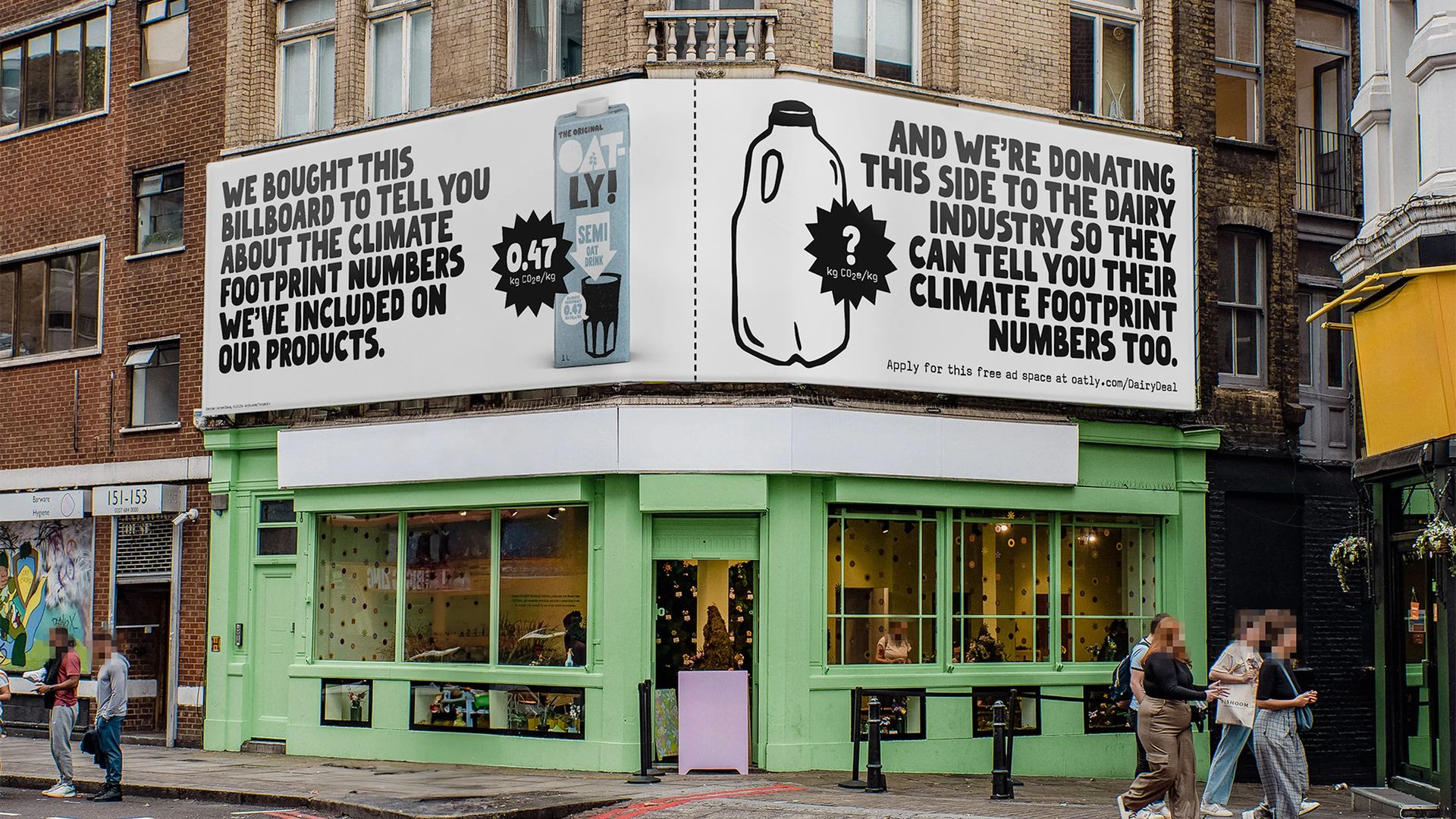
Oatly rented two billboards. Their carbon number on one side, and free ad space for Big Dairy on the other.
It’s a real offer, with an actual link to apply. Up to £121,000 of free media. All Big Dairy has to do is answer 68 questions about their milk’s climate footprint, the same ones Oatly answered.
At first glance, it looks like Oatly's trying to flex their carbon numbers. Oat milk vs dairy milk. But that's not what this is.
The real win here? They backed the dairy industry into a corner. Because look at the ways industry players could respond to this:
Take the deal, and you publish a number that loses.
Turn it down, and the silence is the admission. And the billboard stays up.
Attack Oatly publicly and you look unhinged. They're offering you free billboards, after all.
Not one dairy company applied, of course.
The result? By their agency's numbers, 450 million earned impressions. Oatly ranked the most sustainable F&B brand by UK consumers that year. Might be a bit of greenwashing, but they won this battle.
How do you replicate this? Don't buy a billboard 😅 Just look for a way to back the incumbent you're up against into a corner. What's something you structurally win on that your competitor couldn't possibly challenge?
Onboarding forms, funding paid tests, and backing your incumbent into a corner.
Insight from Joey Noble, Creative Strategist at Demand Curve.
Vitamins vs painkillers, 500K AI citations, and end your ads on emotion.
01.Positioning
Turn a vitamin into a painkiller
Insight from Devon Reynolds, Strategist at Demand Curve.
It’s one of the biggest questions we work through with our Story Systems clients on positioning.
A vitamin is a nice-to-have. A painkiller is a must-have.
Painkillers address a pain the buyer already feels. In our world, that might be revenue lost or a deadline missed. Your copy only has to prove you’re the fastest way out of something they know is happening.
A vitamin addresses a gradual improvement nobody’s currently suffering without. Your message has to create the sense that a problem exists before it can even ask for the sale. That’s the persuasion step a painkiller gets to skip, and it’s much harder.
That gap shows up again after the sale: a painkiller gets renewed because cutting it causes visible damage, a vitamin gets cut first when budgets tighten, because nothing breaks when it disappears.
So you want to be positioned as the painkiller. And you can be, because vitamin and painkiller describe the buyer’s situation. Same product, different buyer, different answer.
Take any cybersecurity company.
They’re a painkiller for a company that just got breached, or one with a compliance audit next month. That risk is about to cost them a client, a fine, or their reputation.
They’re a vitamin for a company that’s never had an incident and assumes it won’t. Nothing’s on fire, so “better safe than sorry” competes against every other line item that sounds reasonable to defer. So it’s the same product, but one buyer is trying to stop bleeding and the other has to be convinced the risk is real.
If most of your buyers are treating you like a vitamin, here’s a bit of good news: You can turn a vitamin into a painkiller by changing who you talk to, and when.
First, timing. Find the painkiller moment hiding inside it. Almost no product is a pure vitamin for everyone. There’s usually a trigger where your product’s absence suddenly causes real, felt pain: a missed deadline, a failed audit, a new hire drowning during onboarding. Market to that moment instead of the general ongoing benefit, and the same product starts behaving like a painkiller for whoever just hit that trigger.
Then, seniority. Sell to whoever in the org actually feels a real cost, even if the end user doesn’t. An employee might see a tool as nice-to-have, while their manager sees the turnover, rework, and lost hours it prevents as a real number on a budget. Find the buyer one level up who actually needs a painkiller.
So: who are you already a painkiller for?
02.AI search
How to get AI citations where legacy sites fall short
Insight from Nelson Isibor, via Saturation, our AI search company.
Here's a tactic for getting cited by LLMs:
Find a category where the authoritative source has real trust but a bad UX.
Think .gov, .edu, legacy media. These pages rank because of what they are, and they’re often slow, outdated, and badly structured. So people search, land there, don’t get an answer, and go looking for someone who explains it in plain English.
You can create content for that person.
Map every real query around that pain point from forums, personal experience, and search data. Then build free tools that solve the specific friction (a checklist, a generator, a finder) rather than just articles. Solve what that person is searching for.
You won’t take position 1 on the incumbent’s own branded queries, and you don’t need it. You might take positions 4 through 9 and get some real traffic. But that’s not what this is about. The real benefit comes from the AI citations.
AI answer engines had the exact same problem finding a good source that humans did. They ground their responses in whatever source is easiest to retrieve and parse. A .gov page has the authority signal, so it gets pulled in. But if it’s thin or badly structured, the grounding step still needs a cleaner source to actually construct the answer from. That’s the opening your page fills.
Nelson gave this a shot against a .gov domain. The results?
Over six months that site took 32,800 Bing clicks and 13,200 Google clicks. It also picked up over 500,000 citations in Bing’s AI answers. ChatGPT alone sent more users than Yahoo and DuckDuckGo combined. And the queries pulling AI citations matched the queries pulling human clicks almost exactly.
Two conditions before you try it. The incumbent has to be bad at serving the query, not just a competitive niche. And this approach needs patience: there were four flat months before the growth curve kicked in, so it’s not a fit for anyone needing fast results.
Nelson calls this gap arbitrage: official authority, poor information experience, unresolved user intent, and whoever fills the gap collects the search visibility and the citations.
03.Copywriting
End your ads on the emotion you want your readers to walk away with
Insight from Nick Costelloe, Content Lead at Demand Curve.
You might've seen this ad from Patagonia at some point.
We've written about it before. I came across it again recently and noticed something I'd missed. Then this post took off on LinkedIn.
Regardless of what you think of Patagonia, this is world-class copywriting.
Read it first. Then read it backwards.
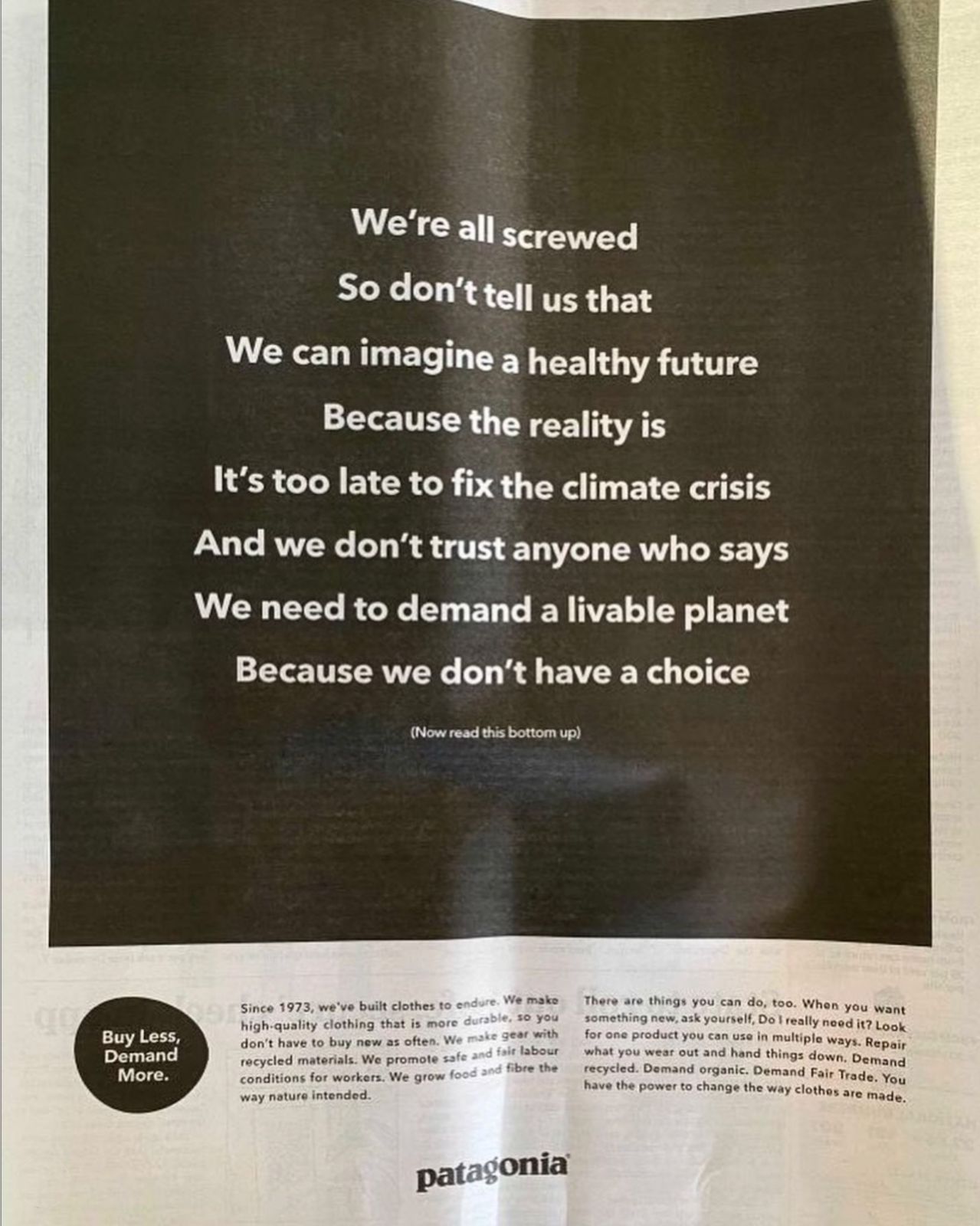
All good copy leans on power words: the persuasive, descriptive ones that make you feel something instead of just understand something. That’s not what’s novel here.
What’s remarkable is that the same words tap into different emotions depending on which way you read them. Top down it’s anger and fear. Bottom up it’s hope.
What I noticed this time is that the feeling you leave with is the one that drives action. The ad is built so you go down first and hit the despair, then climb back up and land on hope. Pessimist turned optimist. That last feeling is what sticks to the brand.
The usual lesson is appeal to your readers’ emotions. That’s table stakes. The more useful lesson is that sequence decides which emotion they walk away with. We justify with logic, but emotion drives what we actually do: share things, donate to causes, buy what we buy. And for Patagonia, a brand that built its entire reputation on sustainability, hope is a huge reason why we buy.
And yeah, “Buy Less, Demand More” is refreshing as hell. A retailer telling you to buy less of their stuff. Same move they made with “Don’t Buy This Jacket” back in 2011, a $57,000 newspaper page their CEO later valued at $40–50 million in earned coverage.
So when you’re writing copy, think about the feeling you want your reader to end with. That’s what they’ll feel when they think of your brand.
Vitamins vs painkillers, 500K AI citations, and end your ads on emotion.
One idea. Two weeks of LinkedIn content.
Insight from Kevin DePopas, Growth Advisor at Demand Curve
Last year I tried my hand at content and generated 900k+ impressions on LinkedIn across 10 posts.
Then I stopped, because I couldn’t keep up with what it took to make them.
I’m a former founder and startup sales, marketing, and growth leader, and last month I went fractional. That means no salary and no team behind me. If the companies I want to work with don’t know I exist, I don’t have a business. Content is how I fix that, and this time I have to do it alongside client work.
Generating content ideas was never the problem. The production was. Recording the raw video, finding the usable takes, cutting the video, adding captions, and scheduling posts always seemed to take longer than expected.
So I recently gave myself a test. Take one idea, record it, and see how much content I can get out of it, in as little time and with as few tools as possible. If I can reliably create six to eight posts from one 10- to 15-minute recording, I have a content process I can sustain.
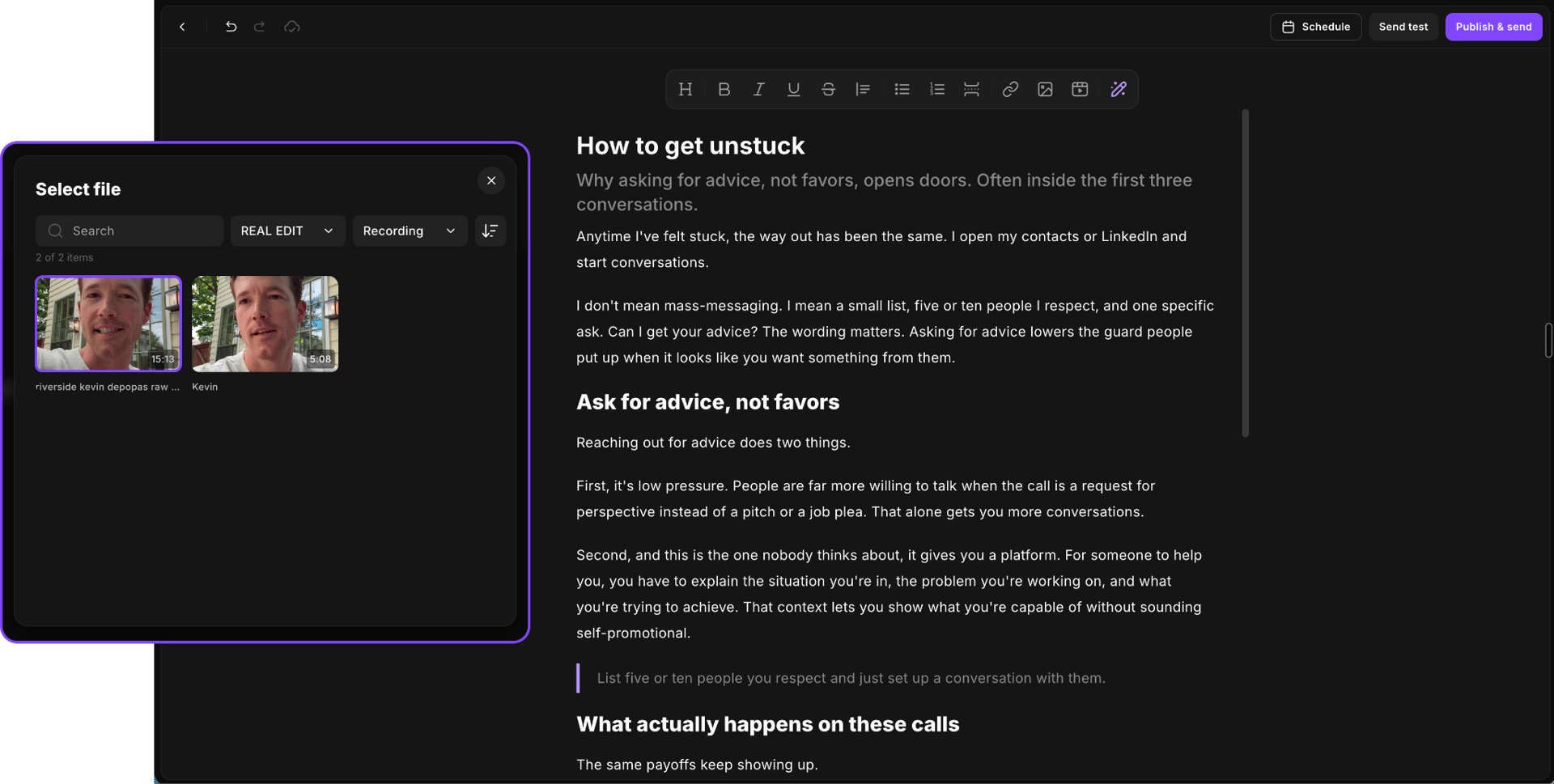
Riverside is the tool I'm using. I've recorded podcasts in it for years, but until this test I'd never touched the editor, AI assistant, newsletter tool, or social scheduler. Since the whole point was as few tools as possible, that's what I used.
If you're a founder, soloist, or creator trying to grow a business with content while still having a business to run, this one's for you. I'll walk you through my process, from choosing a topic to getting posts scheduled, and show you where the time went.
Quantifying my goal
Fractional consulting doesn't need to be high volume. I only need a handful of clients at a time, so I don't need content that goes viral. I need to stay consistently in front of a small group of founders and operators at VC- and PE-backed companies. That means 5,000 to 10,000 impressions per post at about three posts a week, which is what my non-viral posts averaged last year. Over 44 weeks, allowing for some weeks off, that works out to 660,000 to 1.32 million impressions a year. I can work on the rest of the funnel once I’m reliably showing up.
Deciding what I’m going to make
Picking formats I've seen work
A lot of people get hung up on content because they don’t know where to start. My recommendation is to find a format that’s working for other creators and that looks manageable to reproduce.
Video worked well for me last year, so I wanted to keep it as my anchor format. But the specific style of video I was creating took a lot of research, production, and editing. I needed a video format I could make consistently, without as much time or effort.
Alex M H Smith was a useful reference. He talks about business and strategy with a clear topic and a point of view, without elaborate production around it. That looked like something I could do.
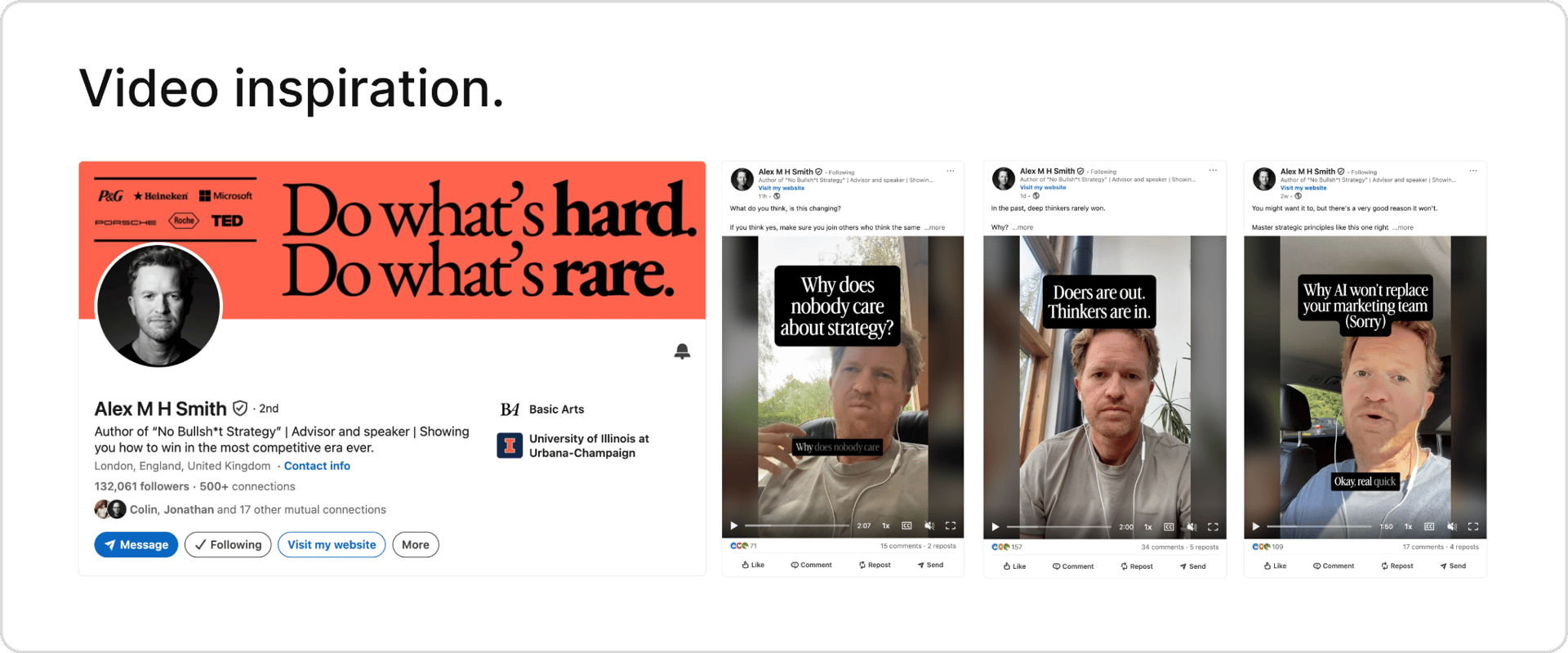
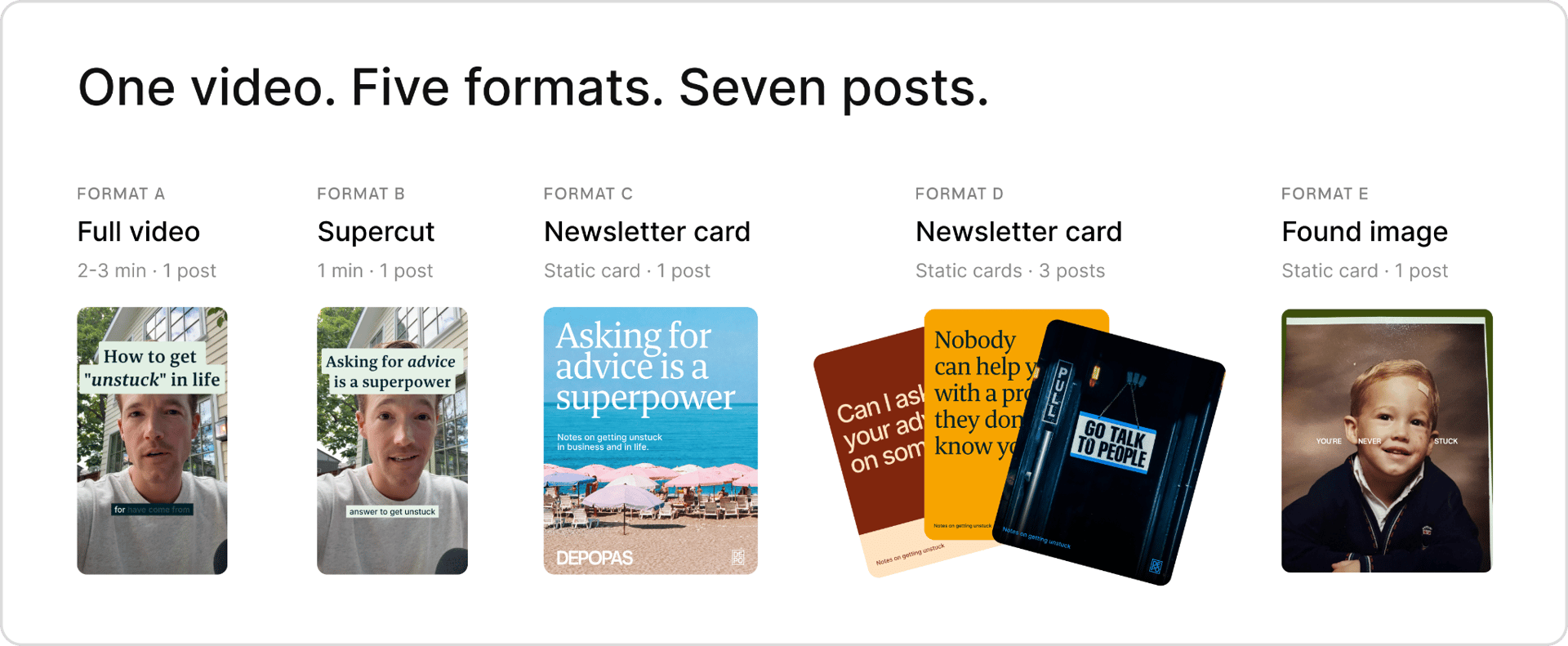
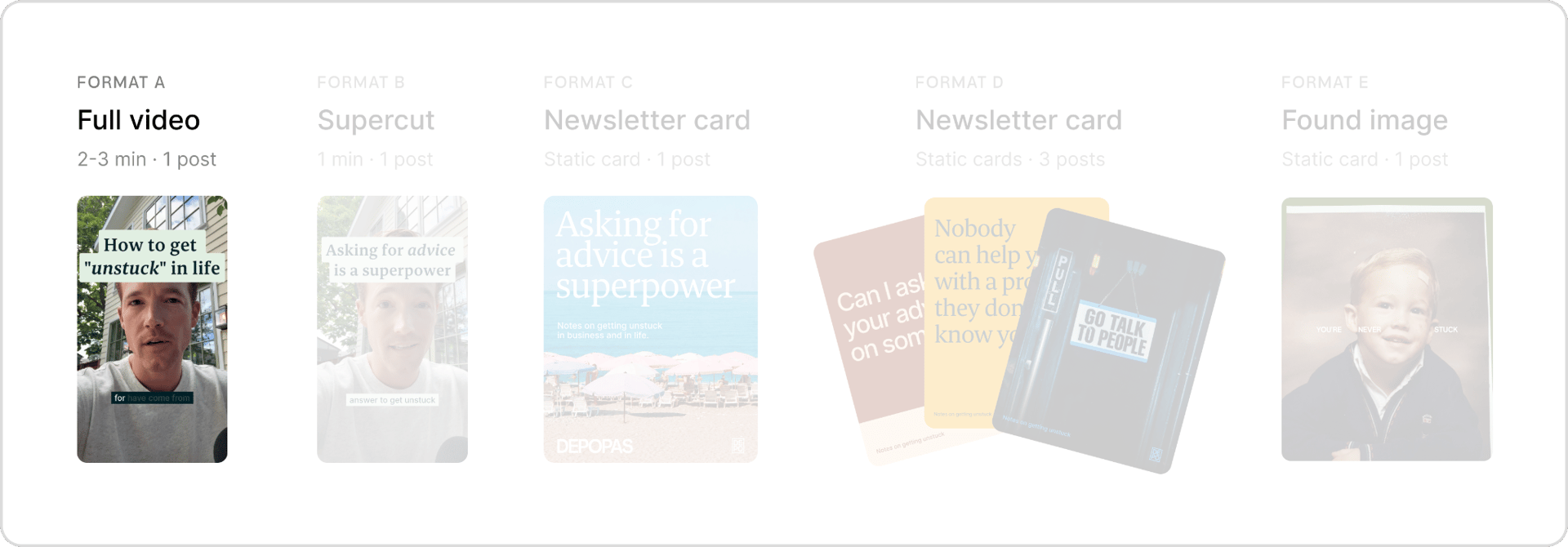
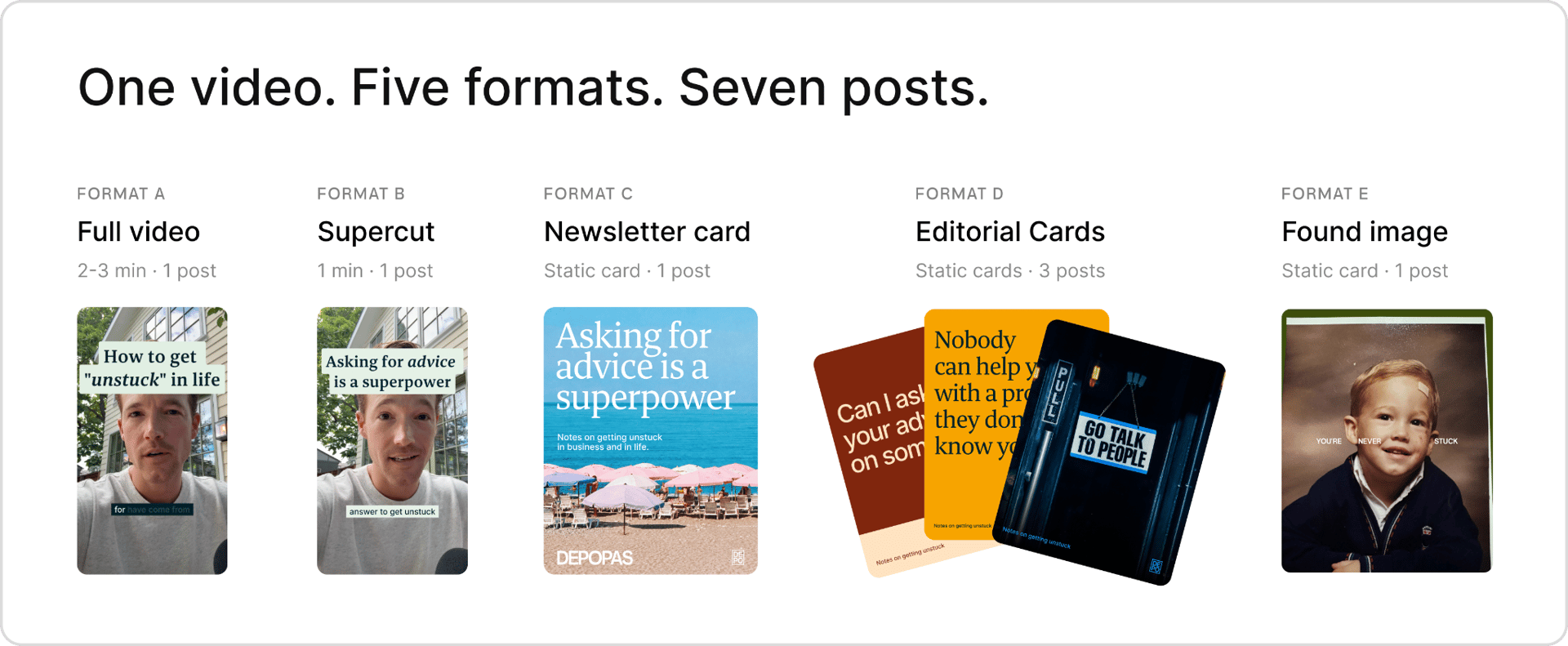
With that as the reference, I chose two- to three-minute videos as my anchor, Format A. Then I picked a few other formats I could build from that recording. Together, they give me seven posts from one idea.
Choosing my topics
Now for the age-old question. What do I talk about?
I generally choose topics I enjoy talking about and feel I have some license to speak about because of my experience. That might be a lesson from my career, a technical part of a job that few people get exposed to, or a pattern I keep noticing in conversations with prospects, colleagues, or founders.
Beyond feeling comfortable with the topic, I want it to create value for the reader. Two questions help me narrow it down.
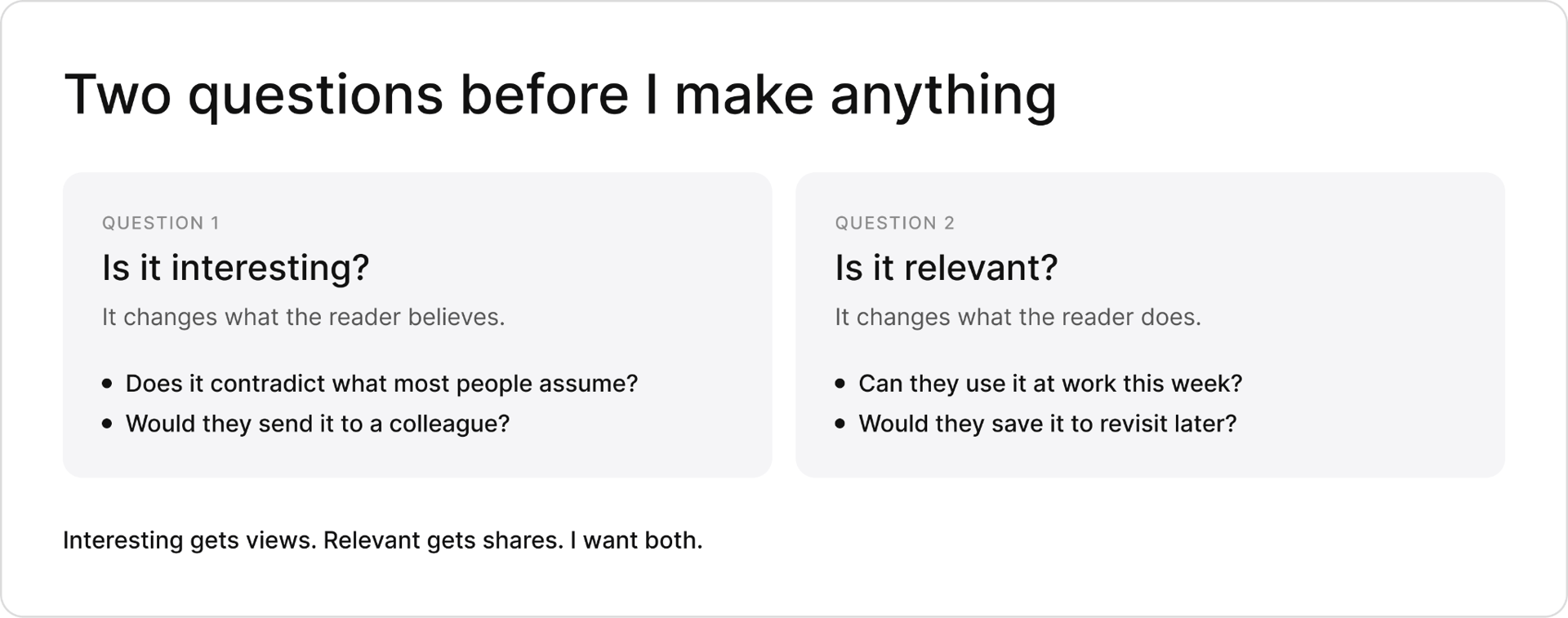
Working through my past writing and recent conversations gave me a list of 400+ ideas, consolidated into the idea bank below.
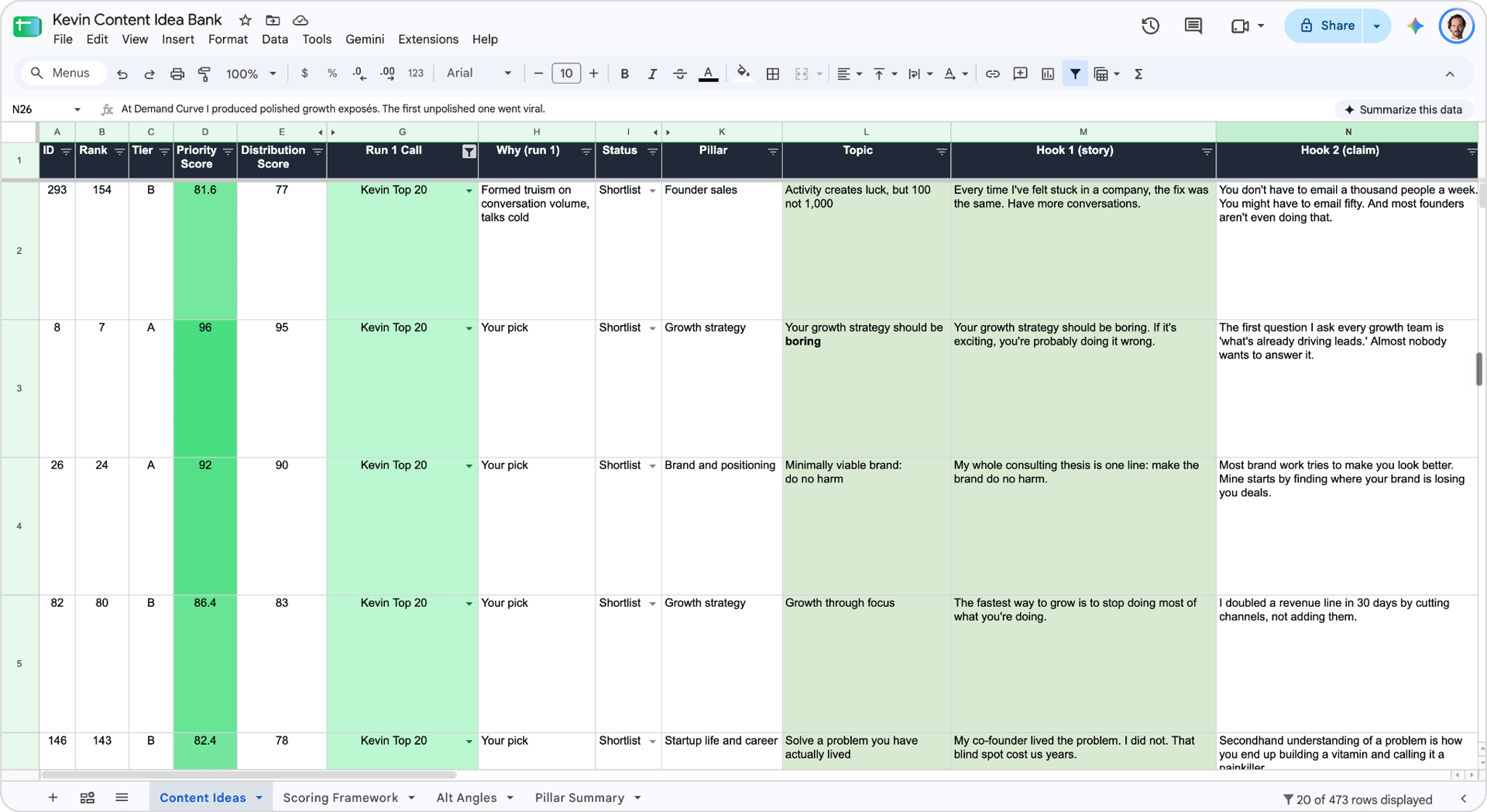
I wasn’t precious about the first topic. Part of the goal is to build the habit of creating and posting, and overthinking every topic won’t help. I went with “How to get ‘unstuck’ by asking for advice,” something I’d recently been giving a friend advice about.
From idea to scheduled posts
With my first topic selected, I worked through the following steps.
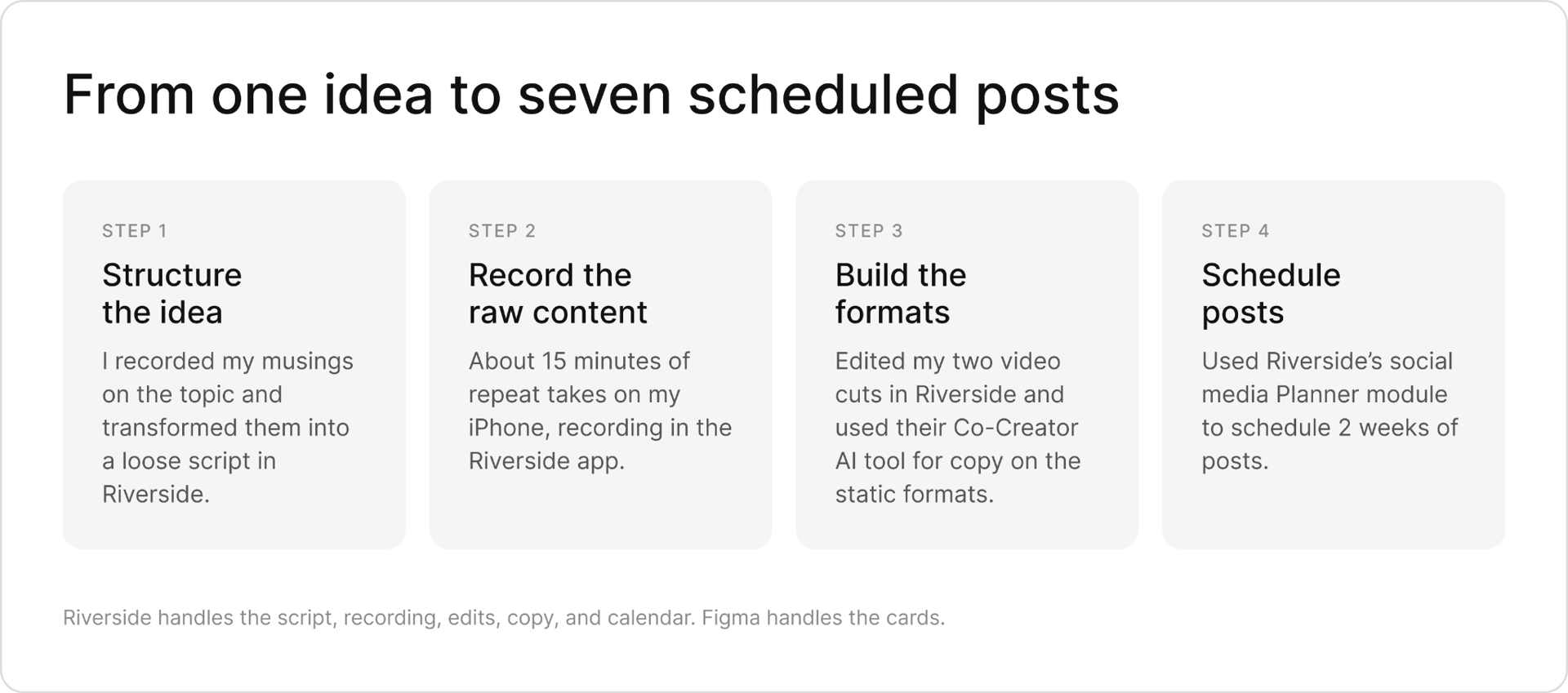
Step 1 · Structuring the idea
Work out the hook, context, and payoff before hitting record.
The structure I’m using
Hitting record without any prep usually means hearing myself say something and thinking, “There’s a better way to explain that,” then re-shooting. So I created a loose outline before recording.
Here was my general structure.
Hook. Start with something concrete and give someone a reason to keep watching. A specific experience or a surprising observation does more for me than a broad statement like “networking is important.”
Context. Give a stranger enough information to follow the story. What was happening, what was difficult, and why did it matter?
Payoff. Resolve the question the opening hook creates. What changed, what did I learn, or what can the viewer do with it?
There’s much more to scriptwriting than I can cover here. Kane Kallaway and Brendan Kane are two creators who go much deeper on these topics.
Developing the script in Riverside
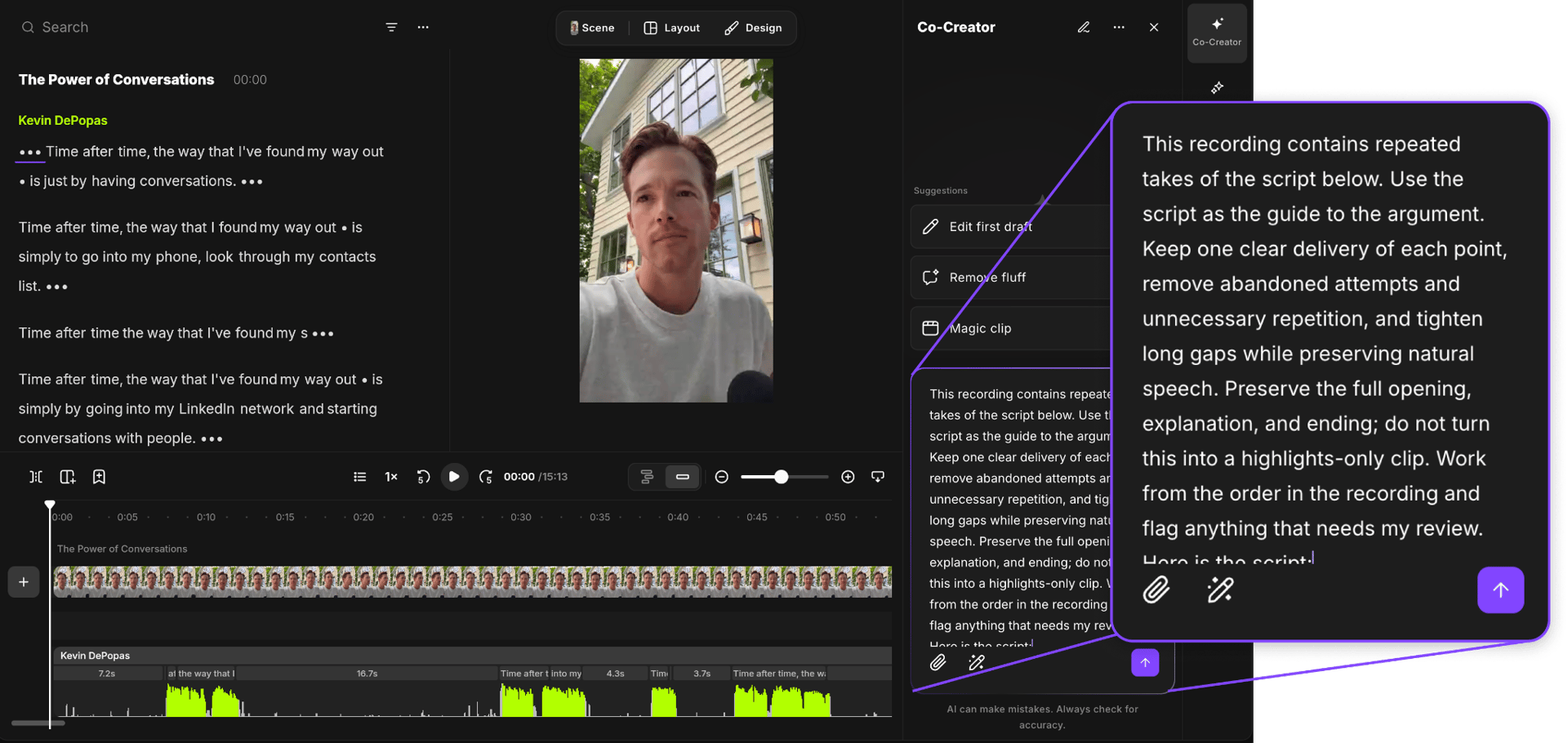
For the “getting unstuck” topic, I started by opening Riverside and dictating my thoughts related to “What to do when you feel stuck” into Co-Creator, its AI assistant. I asked it to turn those high-level, rambling notes into a LinkedIn script with a curiosity-inducing opening, a clear progression, and a useful ending. I also asked it to maintain my tone of voice, word choice, and perspective, remove repetition, and flag gaps rather than make things up.
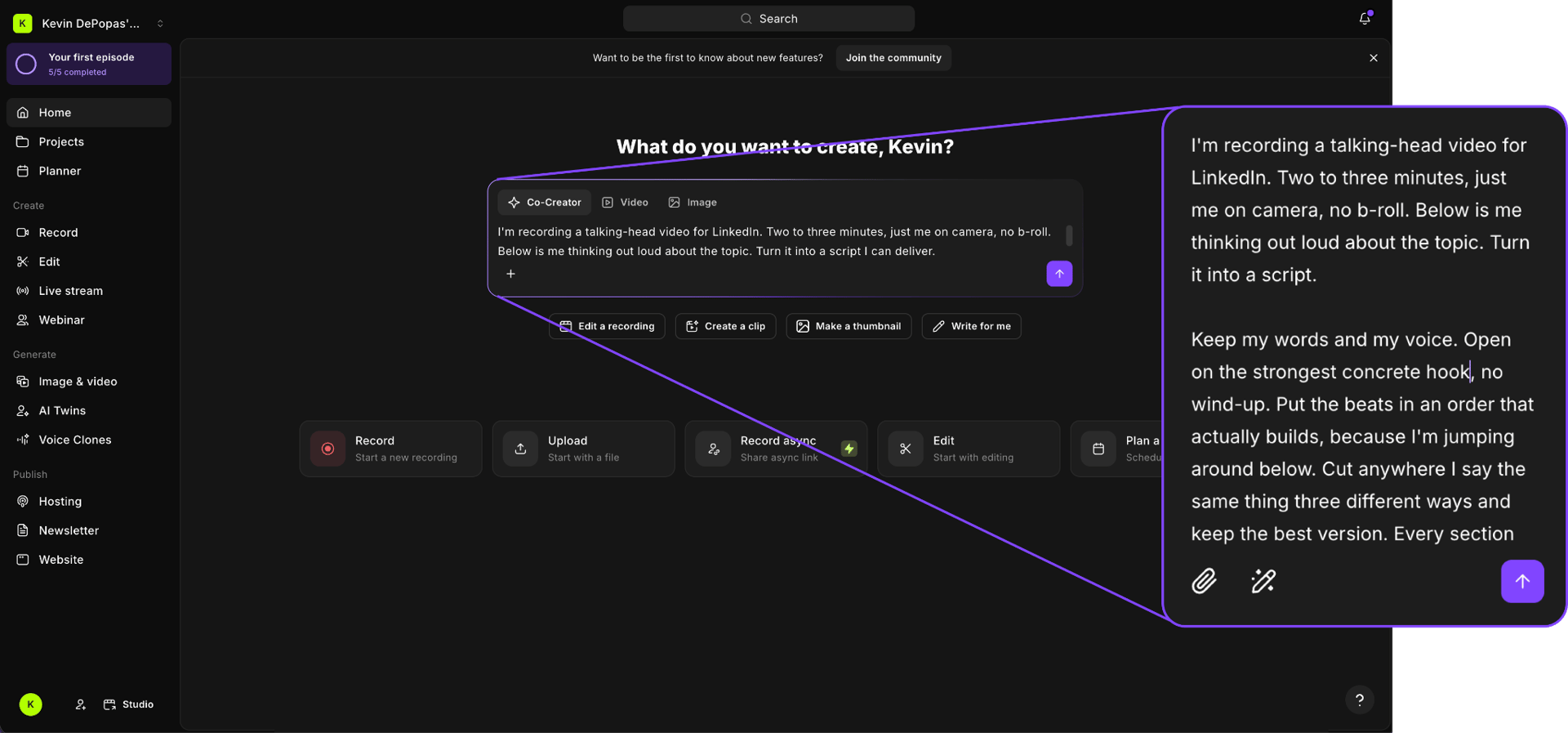
Step 2 · Recording the raw content
My iPhone, a microphone, and about 15 minutes of recording.
I chose a spot in my backyard with an interesting enough background and recorded on my iPhone’s front-facing camera, directly in the Riverside app. Nothing elaborate.
A casual setup doesn’t have to mean a low-quality recording. Riverside records locally on the phone and supports up to 4K, and the footage lands straight in the editor.
I loaded the rough script into the app’s teleprompter so it was visible over the camera preview. Having the words on screen helped keep my place, though it didn’t make me effortlessly articulate the second the camera turned on. Some lines still took a few attempts, and I allowed myself to riff if I felt inclined.
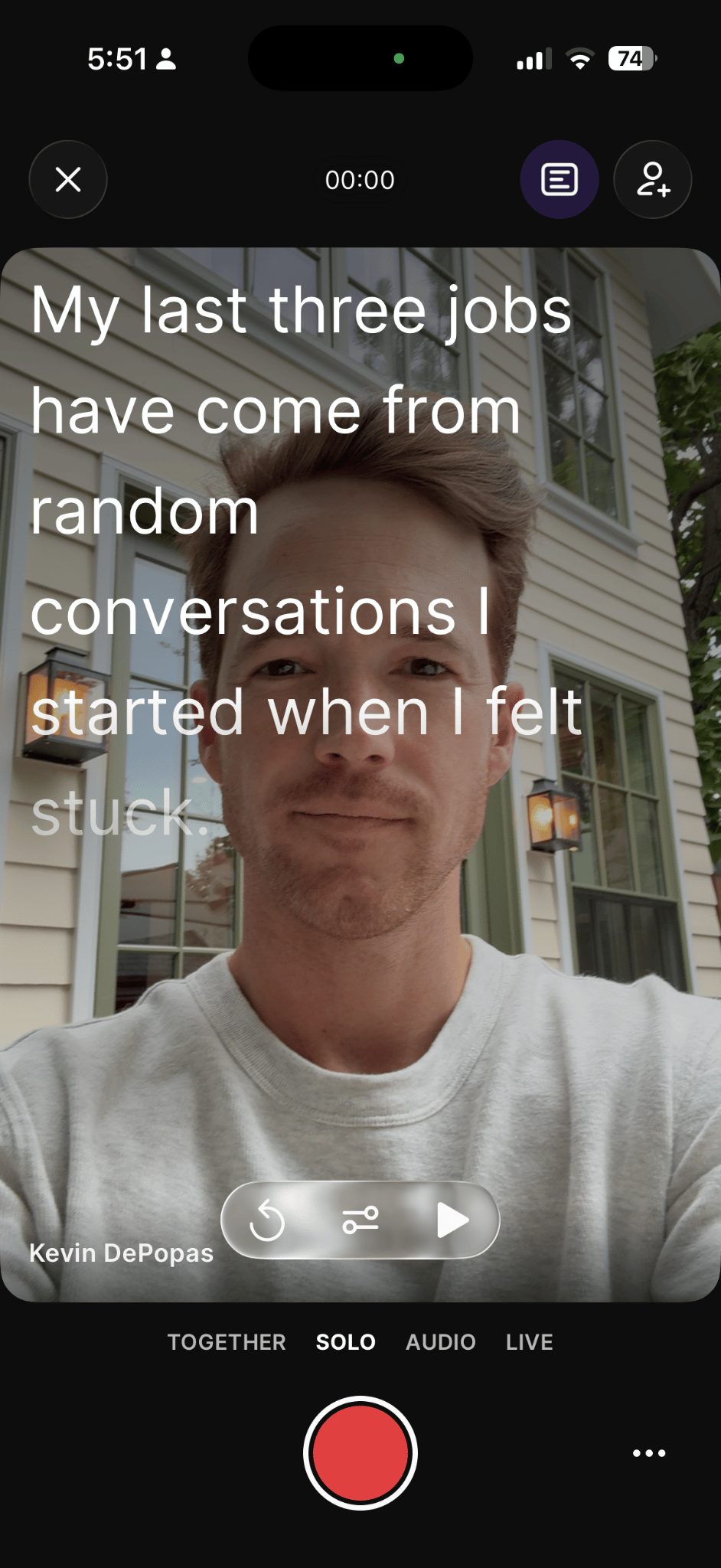
When I stumbled, I paused for a second or two, recomposed myself, and said the line again. If you’re uncomfortable on camera, know that repeating a line is normal. I do it all the time. Getting one usable sentence and moving on is much easier than trying to deliver a whole paragraph perfectly, and each clean attempt gives Co-Creator something to pick from later.
I ended up with roughly 15 minutes of raw footage, including the repeated takes.
Step 3 · Building the formats
One recording becomes two videos, a newsletter, and four static posts.
Format A · Editing the main video
Start with an AI edit
Once the recording was ready in the editor, I gave Co-Creator the script and asked it to find the strongest takes for each point, remove the restarts, and tighten the gaps while keeping the full storyline in the order I’d drafted. I made that explicit in the prompt.
Make any remaining manual edits
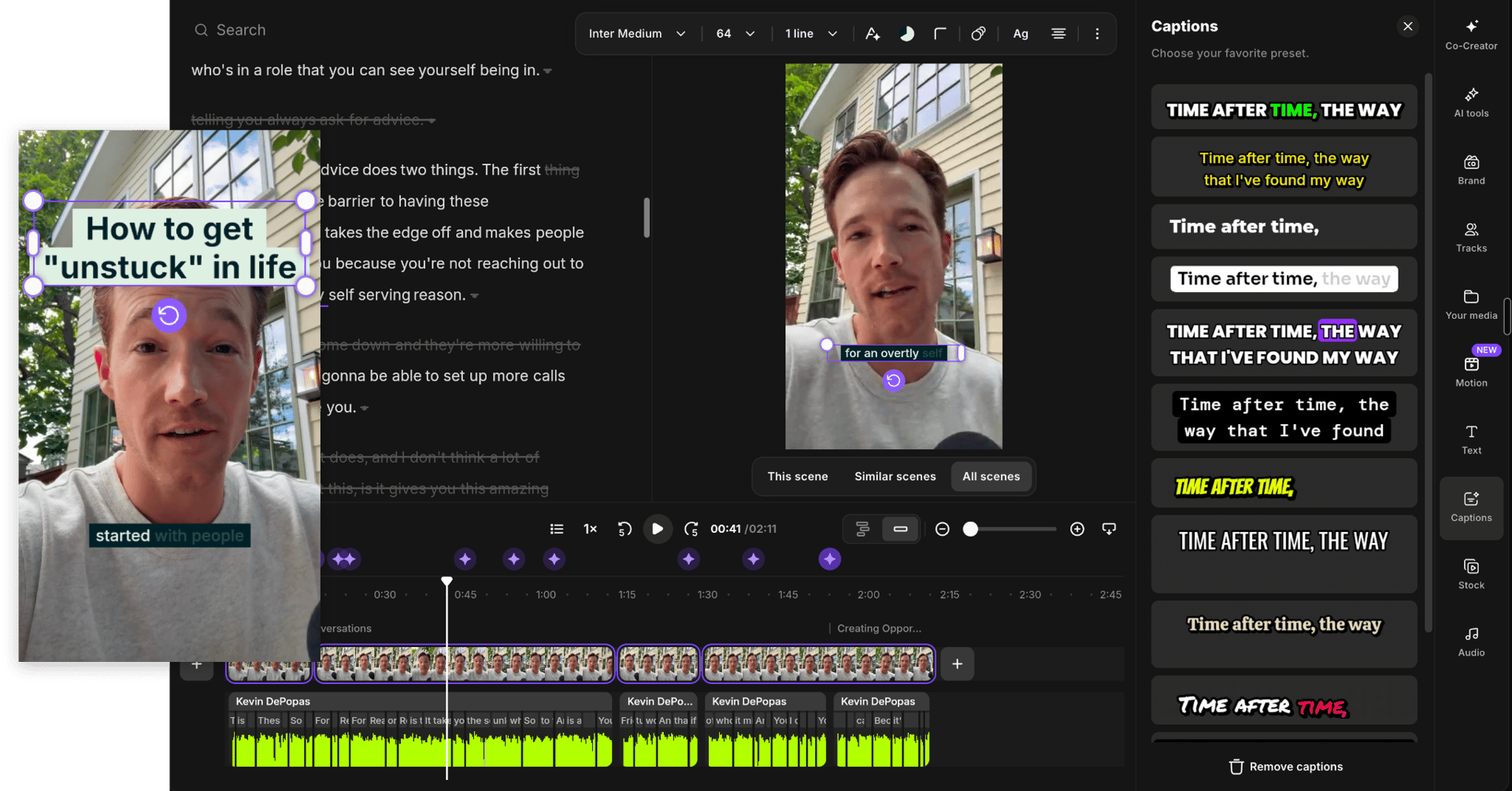
Co-Creator handled much of the first pass of finding useful takes and assembling the story, work that has taken me hours in the past. I watched the cut all the way through, tightened a few remaining pauses on the timeline, and removed wording I didn’t need through the transcript.
Add captions and title text
In the Riverside editor, I opened Captions, chose a preset, and adjusted the font, colors, and placement. The captions come from the recording, so I wasn’t typing and timing every line myself.
I also added “How to get ‘unstuck’ in life” as an opening title directly in the editor. The Text tool handles the styling and timing. My hope is that “feeling stuck” is broad enough for a lot of people to recognize, while leaving them curious about what I suggest doing about it.
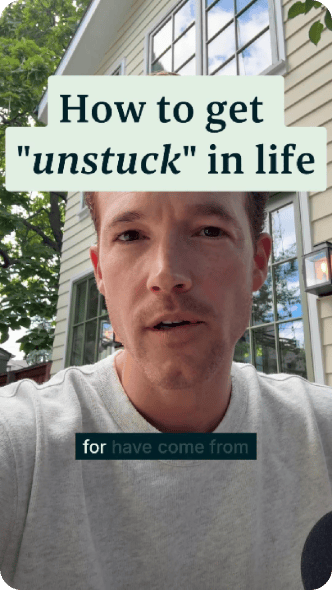
Format B · Making the supercut
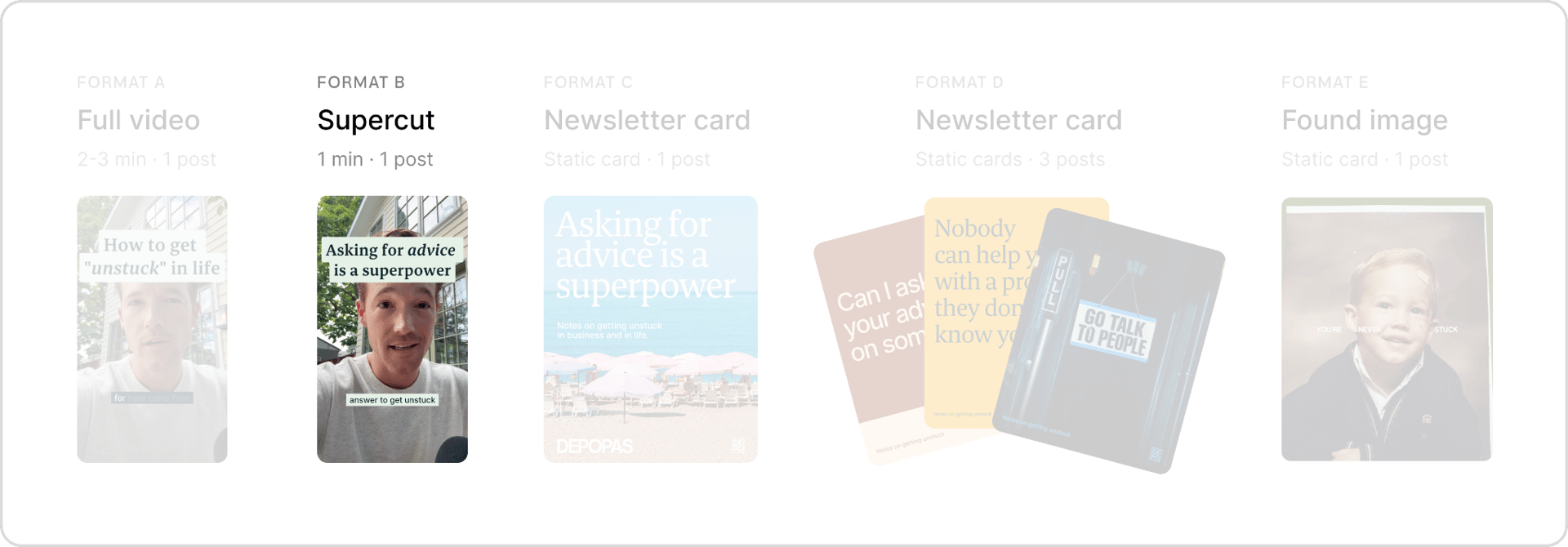
With the full version assembled, I made a second edit that comes at the idea from a different angle. This time I asked Riverside Co-Creator to open on a different hook and keep the essential explanation and the payoff. Sometimes I realize a different way to arrange the piece after the first edit, so I push myself to try another version even when I’m attached to what I recorded.
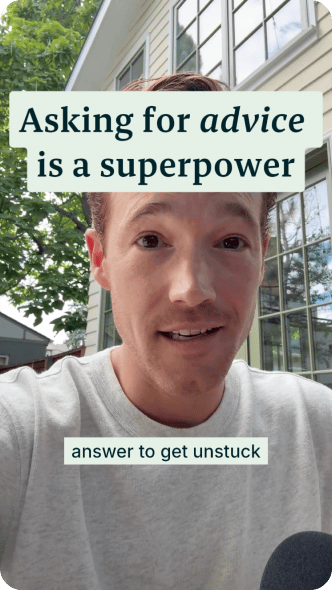
Format C · Creating a newsletter and a social card
If I’ve already worked out an idea for a video, I have the start of an article. I hadn’t picked a newsletter platform yet, so I tried the one inside Riverside and used “Generate from file” to turn the recording into a first draft. As with any AI draft, it still needs the claims checked and the voice fixed before it goes out.
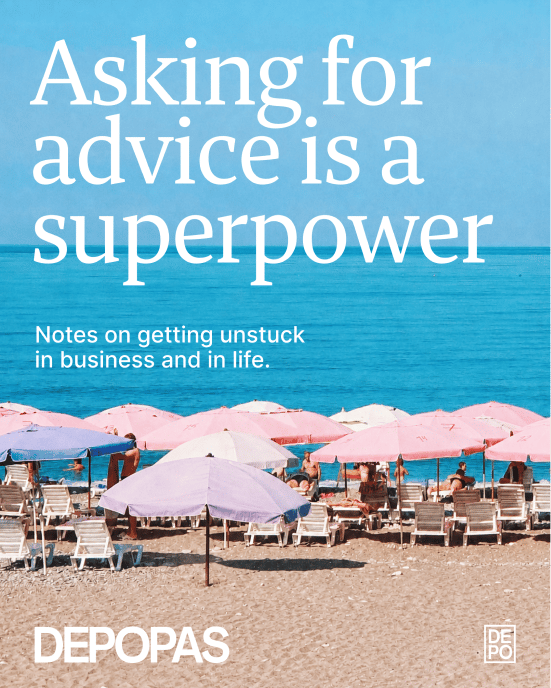
For LinkedIn, I paired a simple newsletter card with a post introducing the idea and inviting people to read the article.
Formats D and E · The posts I made outside Riverside
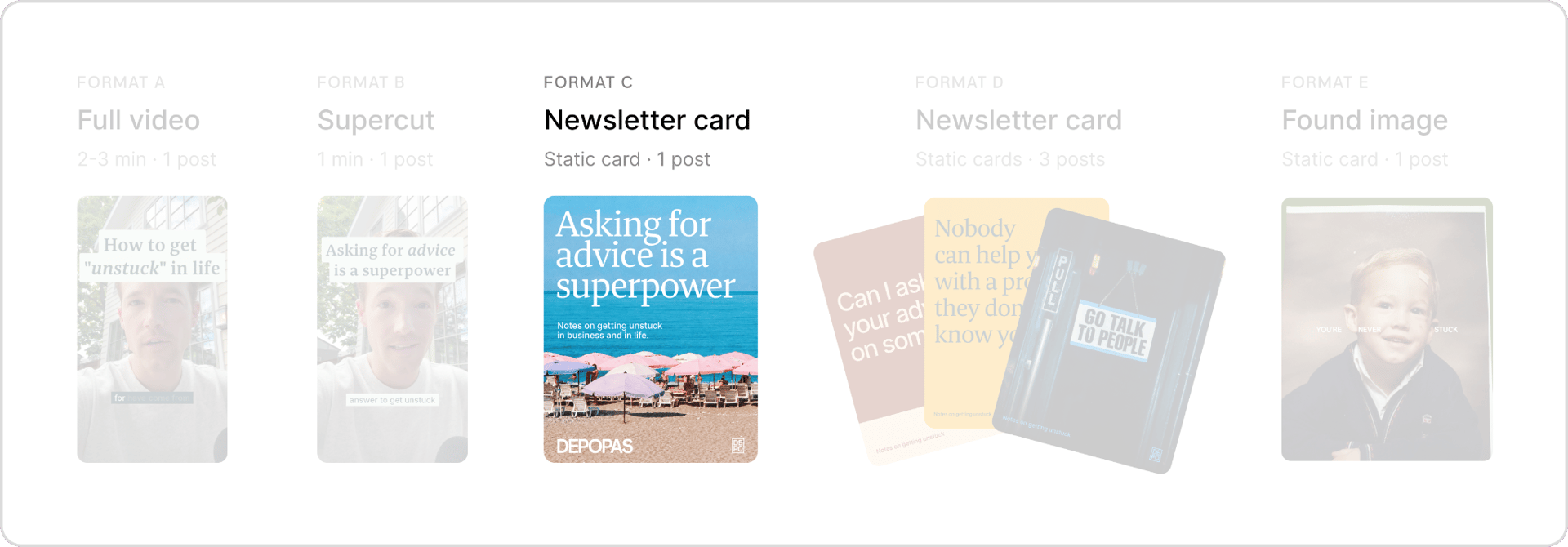
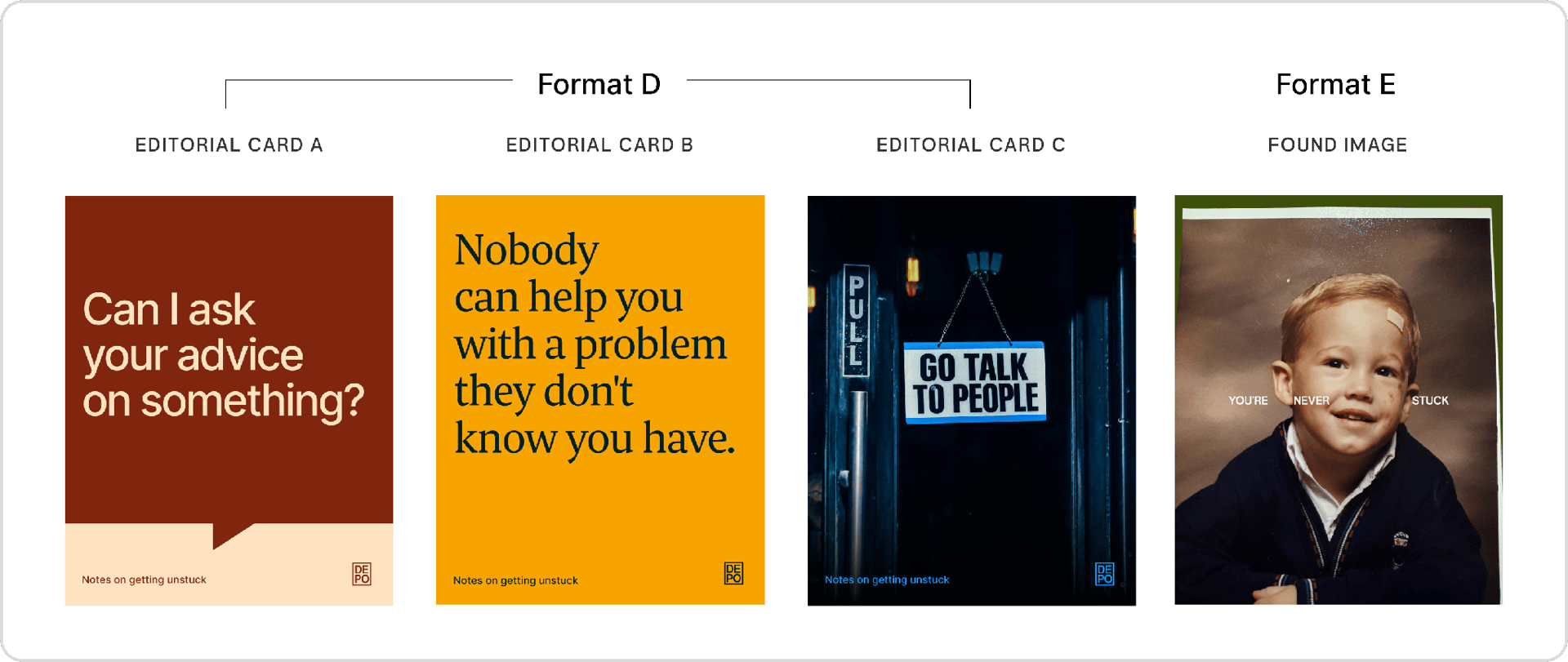
The same recording also gave me three editorial cards and a found-image post. A longer piece usually has several story beats that can stand on their own, and Co-Creator pulled these three hooks out of the transcript.
Can I ask your advice on something?
Nobody can help you with a problem they don't know you have.
Go talk to people.
I built the cards in Figma. For the found-image post, I used a photo of me as a kid and wrote the post as advice to a younger me.
Writing the post copy
I created the LinkedIn copy as a batch. I gave Riverside Co-Creator five of my previous LinkedIn posts as a writing reference and used the recording as the source material for the seven drafts.
I’m testing different approaches to the copy depending on what accompanies it. For the videos and the newsletter card, I want the post text to set the hook without closing the loop, leaving someone curious enough to press play or read the article. For the editorial cards and the found-image post, the insight has to be complete in the post itself, so someone gets something useful without leaving the feed.
Step 4 · Scheduling the posts
Three posts a week for two weeks, scheduled from the Planner.
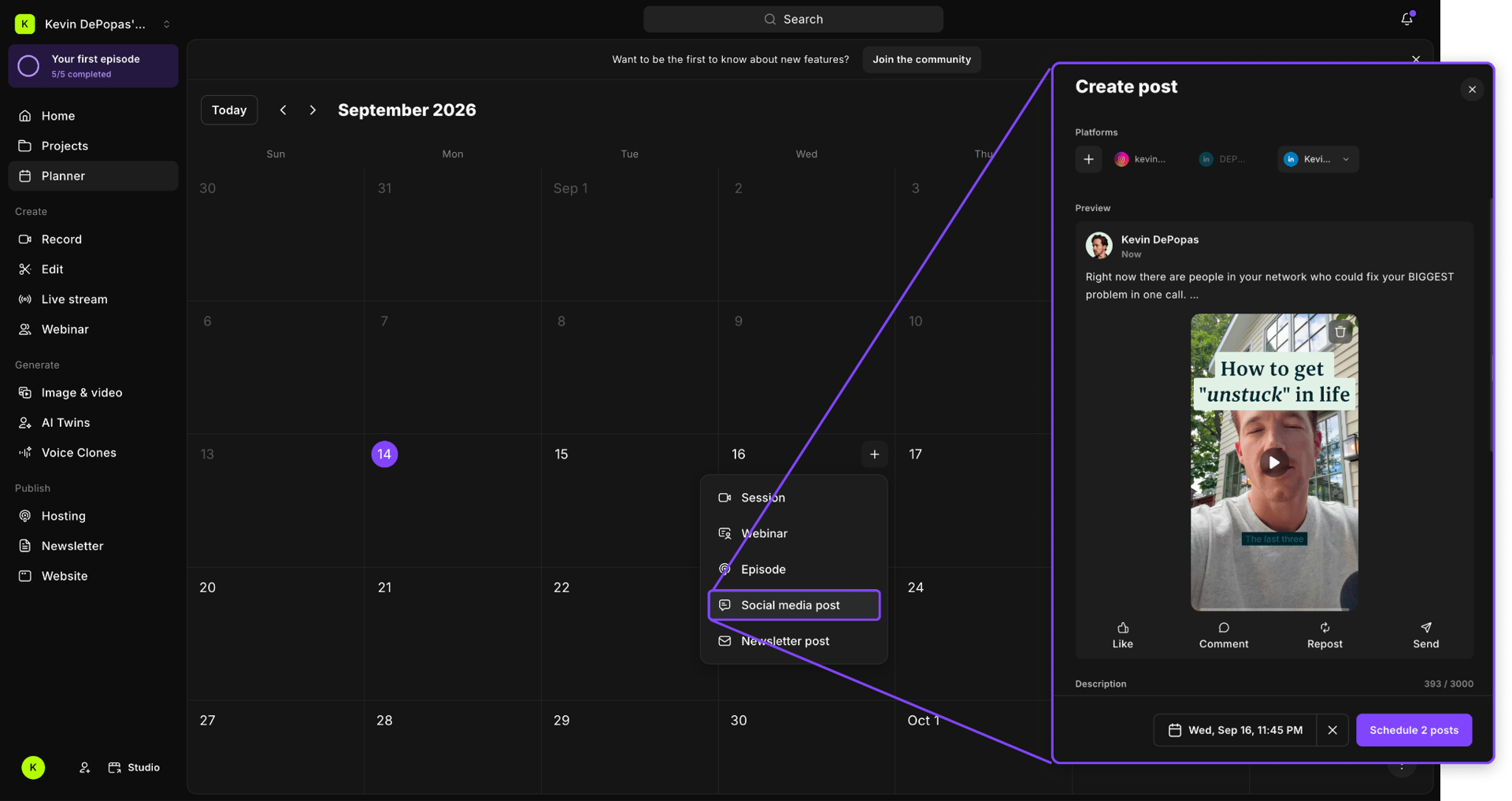
In Riverside’s Planner, I created a social post, selected LinkedIn, and connected my profile. Then I selected the asset, added the post text, and chose a publication date and time. The videos were already in my studio, so they were easy to schedule. For everything else, I uploaded to the Planner.
Takeaways
I got seven LinkedIn posts from roughly 15 minutes of raw footage. That gives me two weeks of content at the cadence I’m aiming for, and I’m pretty happy with the result.
The first run took longer than it will next time, since I was learning the tool and writing this piece as I went. Now that the process is set, I'd estimate six to seven hours from picking a topic to seven scheduled posts.
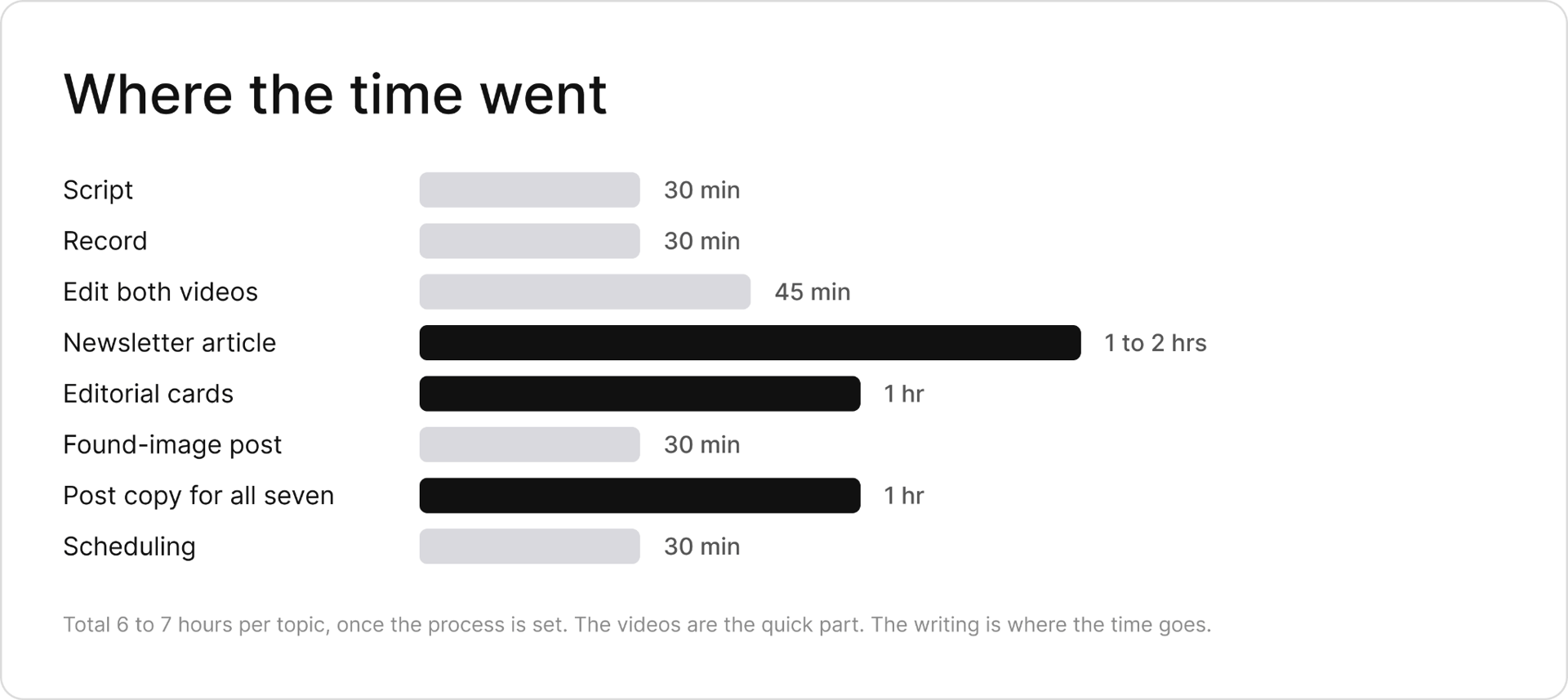
Video edits are the part people assume takes forever, but in this workflow, they were actually one of the quickest parts. The writing often takes the most time. If I run this motion twice, it will cost me 12 to 14 hours for a full month of content.
Repeating a topic
You might be wondering whether seven posts on the same topic will get repetitive for the people who follow me. I’d be more worried about that if I expected everyone in my network to see all seven. Think about your own feed. How many of your connections’ posts do you actually see in a week? Different formats and openings give the idea more chances to reach someone it’s useful to.
I’m also trying to be less precious about what I post. Once, when I was overthinking a post going live, Demand Curve co-founder Neal O’Grady told me, “Kevin, the nice thing about interest-based algorithms is that if the content’s not good, nobody sees it.” For whatever reason, that took a lot of pressure off. I still want to put thought behind what I publish, but at some point I have to post it and see what happens.
My experience using Riverside
I shaped the script in Co-Creator, recorded with the teleprompter, let it assemble a first cut, then edited the transcript, added captions, and drafted the newsletter and post copy from the same recording. Every call on the output was still mine. It just got my ideas into publishable form a lot faster than my old process.
One final point to remember. Good content takes effort. If a tool makes it effortless, with minimal thought or nuance from you, I hate to say it, but the final product probably isn’t going to be that good. The nuance behind an idea, the examples you choose, and the care you put into explaining it are what make it interesting.
To see the pieces as they come out and find out how they perform, follow me on LinkedIn. I’m timing the first post to go out alongside this newsletter, and I’ll share what I learn as I go.
And if there’s a recording you’ve been putting off, try the workflow with one idea. Use code DEMANDCURVE for one month free of Riverside Grow.
– Kevin
One idea. Two weeks of LinkedIn content.
Insight from Kevin DePopas, Growth Advisor at Demand Curve
The visuals that belong on your landing page, how to tell whether your differentiator will last, and why pricing low can leave you unable to afford customers.
01. Landing pages
Show the dream, then the dashboard
Insight from Joey Noble, Creative Strategist at Demand Curve
Every visual on your landing page answers one of two questions:
What is this, or what happens to me?
- What is this? Show the product.
- What happens to me? Show the outcome of using the product.
Say you sell distribution software for musicians. You could show the dashboard: upload a track, push it to Spotify and Apple Music. That's useful. It explains the product.
But what does the musician actually want? Probably not a really good distribution dashboard. They want people listening. They want fans. They want recognition. Some of them are picturing a stage and a few thousand faces looking back.
So the stronger shot is the artist on stage, looking out at the crowd. The dashboard is the mechanism, but the crowd is the dream.
There's a term for why this works: mental simulation. People want an outcome more once they can picture themselves having it, and a screenshot leaves them to do that picturing on their own. Faces do work a UI can't. Someone celebrating a result says something a dashboard reading "+23%" doesn't say by itself.
You don't need to swap every product shot for lifestyle photography, or fill the page with stock photos of people laughing at laptops. Nobody has ever laughed at a laptop. You need a mix of both product and outcome visuals. Show me the dream, then show me why I should believe your product can get me there.
Pull up your own page and count your visuals. Most pages answer what is this six times and never get to what happens to me.
02. Positioning
What kind of differentiator are you standing on?
Insight from Devon Reynolds, Growth Strategist at Demand Curve
Okay, so you did the work and you have a great value prop.
We’ve written plenty about value props. In our #339 newsletter, we ran an exercise for finding a claim that's actually yours: list the bad alternatives, write down what specifically makes each one bad, then keep only the claims your closest competitor couldn't paste onto their own site.
That gets you from benefit to value prop. That's important work.
But say you did that and landed on something solid. There's a second question worth asking before you build a funnel on it:
How long does it stay yours?
Look at the failure your claim points to and ask what it would take for a competitor to answer that same failure. The best advantages are moats: things like proprietary data collected over years, distribution or trust relationships that took time to earn, network effects, a regulatory approval. Incumbents can copy a feature, but they can't copy five years of your customer data.
Most differentiators aren't moats. They're a specific feature, workflow, or claim, and a well-resourced incumbent watching a smaller company win with one will often just build it. Snapchat's whole positioning was posts that disappear. Instagram shipped Stories in August 2016, and by January it had 150 million daily users, about the size of Snapchat's entire app. In the quarter after launch, Snapchat's sequential daily user growth fell to 3.3%.
That doesn't make the short-term differentiator worthless. You can still run with it, build on it, sell with it. But it's important to know which kind you're standing on, because a moat is worth building your whole brand on and a one-year head start is worth a campaign. So if your current differentiator isn't one that'll last, start working on your next claim before someone closes the gap on this one.
03.Pricing
Price high enough to afford customers
Insight from Marc Andreessen, via Startup Archive.
Pricing usually gets decided as a revenue question.
What will people pay, what does it cost us to deliver, what are competitors charging?
But it's also a marketing decision.
Here's what often happens: You price low so the product is easy to buy. The low price means each deal brings in too little to justify a real sales and marketing effort. So you can't afford the rep, the ads, or the outbound that would get the deal in the first place. Sales stall, and the instinct at that point is to cut price again, which makes it worse.
So what happens if you price high instead? The same loop runs in your favor. Marc Andreessen has been telling founders this for years: price high and you can fund a more expensive sales and marketing effort, which makes you more likely to win the market, which pays for the R&D you want later. He thinks engineers treat price and value as a one-dimensional tradeoff, pricing a product nobody can replicate as if it were a commodity. Higher prices and faster growth go together.
The rule underneath it: price by value, not by cost. Selling to businesses, charge as a percentage of the business value you create. For an AI product, price against marginal productivity. If the tool makes someone better at their job, charge against the size of that gain.
One more reason a high price isn't the customer-hostile move it looks like. Higher price means higher margin, which means more money going back into the product. Most buyers aren't hunting for the cheapest option, they want the thing that works best. And pricing high makes that possible.
HOT OFF THE PRESS
News you can use
- Amazon is being sued by the FTC and 22 state attorneys general over its ad auctions. Advertisers were told they'd pay a cent more than the next-highest bid; the complaint says Amazon added an undisclosed price floor in 2019, plus a fake bidder to push winners higher. Over a million brands and sellers are covered, so if you've run Sponsored Products since 2019, you're one of them. (FTC)
- Google won't have to sell AdX. Judge Brinkema threw out all three of the DOJ's structural remedies on Sept 2 and took the behavioral ones instead, then sealed her reasoning for 14 days. The real obligations should surface soon. (PPC Land)
- Google Ads is invalidating promo credits after advertisers spend to earn them. Consultant David Melamed watched it hit two clients, one a $3,200 credit marked "Invalidated" a month after the client spent the qualifying $3,200. Nobody's found an appeal path, so go look at yours. (Search Engine Roundtable)
The visuals that belong on your landing page, how to tell whether your differentiator will last, and why pricing low can leave you unable to afford customers.
Trade a trial extension for a review, spot where AI video crosses the line, and turn discounts into credits
1. Trade a trial extension for a review
Insight from Joey Noble, Creative Strategist at Demand Curve
Three days before our trial ran out, a tool we’re testing offered us two extra weeks. All we had to do was leave a review.
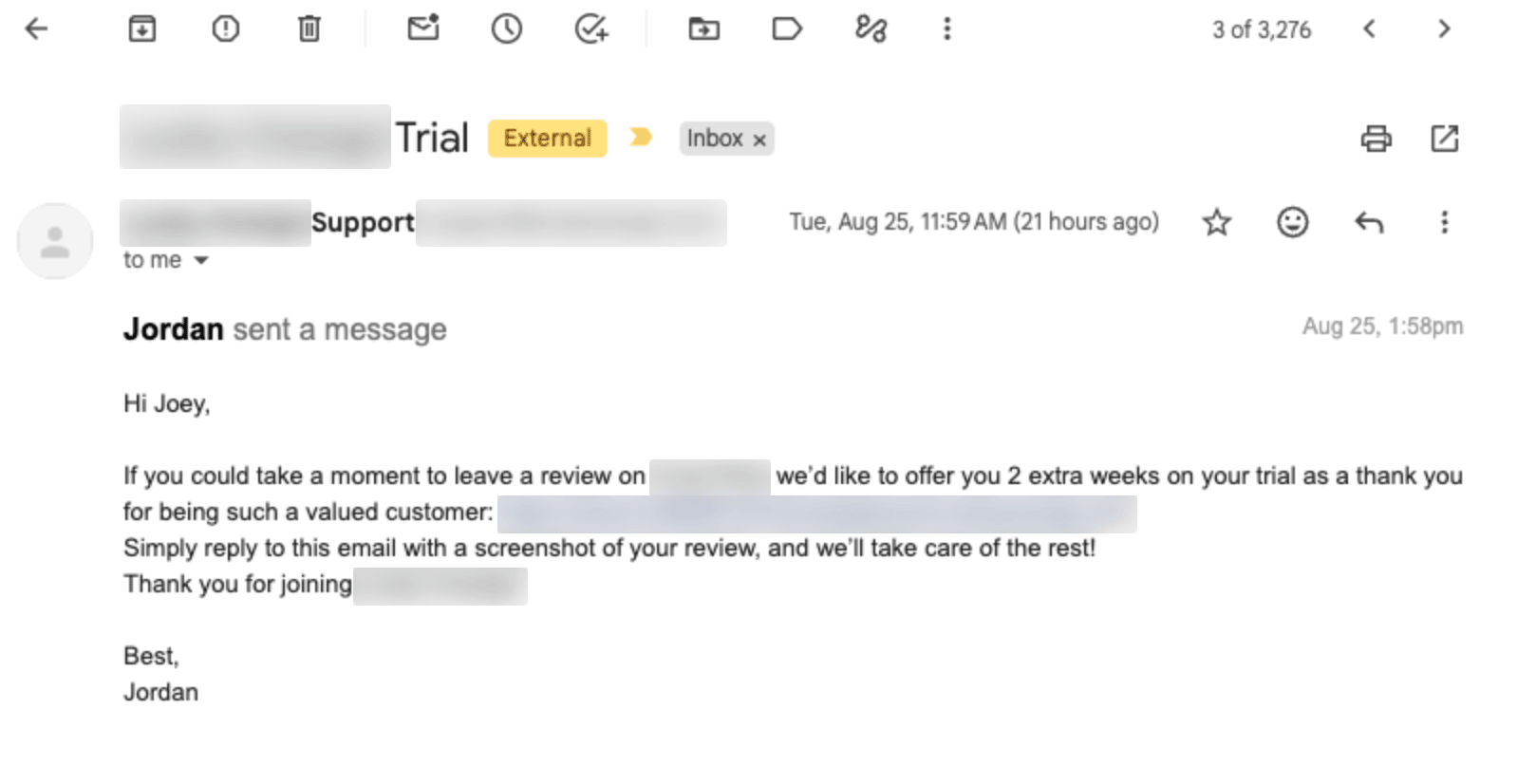
Good approach. Here’s why:
- It buys more time in the product. Two extra weeks is two more weeks of data piling up in the account, and more data makes this particular tool more useful. For any product that gets better the longer it runs, extending a trial is a cheap way to help people get real value out of it before they have to decide.
- It self-selects. Any trial extension does the first thing. This one adds a filter. The people who want two more weeks are the people already getting something out of it, so you’re sourcing social proof from the people most likely to leave you a good review.
- The small ask makes the big one easier. Psychologists call this foot-in-the-door: agreeing to a small request makes people more likely to agree to a larger one later. Writing a review is a small yes. Paying is the bigger one.
One catch: check your review platform’s rules before you send the email. You can offer a reward for a review on your own site, but some third-party review platforms don’t allow freebies in exchange for one. And never make the reward contingent on the review being positive.
2. Where AI video crosses the line
Insight from Devon Reynolds, Growth Strategist at Demand Curve
AI video has gotten really good. Cheaper creative, faster testing, better-looking ads than most brands could afford to shoot. But there's clearly a line somewhere, and this ad crossed it.
I got served an Instagram ad for a puzzle. At first it looked like a normal product video. Then I noticed the pieces weren't fitting together right. Some of them appeared out of nowhere as the puzzle came together.

Watch the flower's center fill in on its own. The petals change shape too.
My immediate reaction wasn't "oh, this is an AI ad." It was "wait, is this product even real?" Or “were they showing me something the real product can't do?”
There's an ethical question here, but I think the business argument is more interesting. AI lets us make good-looking creative fast and cheap. Use it to simulate the actual product, though, and you risk undermining trust in the entire company. The second I caught the fake puzzle, I questioned everything else they were telling me. The same video says these are waterproof, for example. Why would I believe that now?
Right now brands get caught because a hand looks weird or the puzzle pieces don't fit correctly. Soon those tells may disappear. So "will people notice?" probably shouldn't be the standard for whether you do it. A more useful test: does this create an expectation of the product that the real product can't meet? This goes beyond physical products. Imagine an AI-generated SaaS demo showing functionality that doesn't actually exist, or an AI-enhanced hotel room that looks much better than the real one.
Cheap synthetic creative might make the human stuff more valuable. Real product demos, customer videos, screenshots. As feeds fill up with AI, those become the strongest trust signals you have.
3. Turn your discount into a credit
Insight from Nick Costelloe, Content Lead at Demand Curve
Cadence, an electrolyte brand I've bought from before, sent me a win-back email last week. The way they framed it is worth trying. Here's the email:
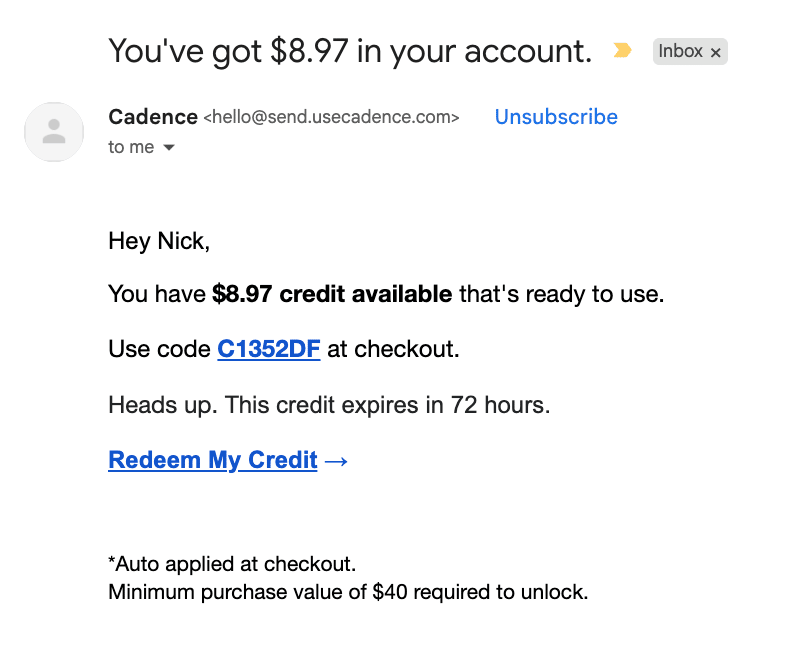
Simple, sure. But it’s a reframe too few companies use.
Offer 20% off your next order and the customer loses nothing by ignoring you. Put the same amount in their account as a credit and ignoring you means throwing money away.
We value a thing more once we feel we own it. That's why losing something you own stings more than missing out on something you never had. The discount is the same, it just doesn’t feel the same.
Now look at the number they picked. Not $10 off. $8.97. Brands don’t round a promo to the cent, so it reads like a balance someone calculated for me. The subject line says “in your account.” The body says “credit available.” And the minimum purchase is visible in the email, not an unpleasant surprise when you hit the redeem page. The whole email looks more like an account notification than a promo.
Then you get 72 hours before the money you supposedly own disappears.
News you can use
- Meta's taking placement exclusions out of ad sets. There's a notice showing up in Ads Manager: no more excluding placements, platforms, devices or operating systems at the ad set level. No date on it. Jon Loomer, who caught it, thinks it's a test on Sales and Leads campaigns only for now, and that value rules are what you'll use instead. (Jon Loomer)
- Google's testing channel controls inside PMax. It's an alpha called Channels, and you nudge Search, YouTube, Display, Discover, Gmail or Maps up or down. Up means Google will accept a worse CPA there, down means it won't. Not a budget split. Be careful with it: if YouTube's CPA looks bad because Search is taking the credit, turning YouTube down can wreck Search too. (Search Engine Land)
- Google's auto-expanding AI Overviews on some searches now. No "Show more" click, the whole answer just loads, an AI Mode box sits under it, and your links get shoved down the page. Google confirmed it and won't say how many queries. Definitions are the one spot it shows up reliably, so go pull your "what is" queries in Search Console while you've still got a baseline. (Search Engine Land)
Trade a trial extension for a review, spot where AI video crosses the line, and turn discounts into credits
Avoid shrinkflation, what to do when building in public stops working, and how to make your product a ritual.
1. Raise the price, don't shrink the product
Insight from Demand Curve, inspired by a BBC News article.
A cleaner in England found an unopened Mars chocolate bar from 1991. It weighed 62.5g. Today's Mars bar weighs 40g in the UK.
Classic case of shrinkflation.
When costs go up, you can charge more or give less. Giving less feels safer, because price is the number customers watch. They remember what something costs, they're not tracking grams.
The research is split on this. Some studies show that companies squeeze out better margins. Others show that people prefer paying a little more for a product than paying the same price for less.
If you shrink, margins look better for a bit. Then someone notices, and now you're the brand that tried to pull one over on your customers. To a lot of people, shrinkflation is just lazy marketing, and a desperate grab for a little margin.
We think the better move is to raise your prices and be upfront about it.
This is most relevant for CPG startups. But it applies across the board. The software version of a smaller Mars bar is a feature that moves up a tier without an announcement, or the free plan that drops from three devices to one. The physical version is the cheaper component in the same box. They all keep your pricing page intact and count on nobody noticing.
Somebody always notices. Mars trimmed the bar to 58g in 2008, then 51g in 2013, then 40g this past March. Eighteen years of trims, and one photo put all of them back in the news. Don't sweep it under the rug, figuratively or literally :)
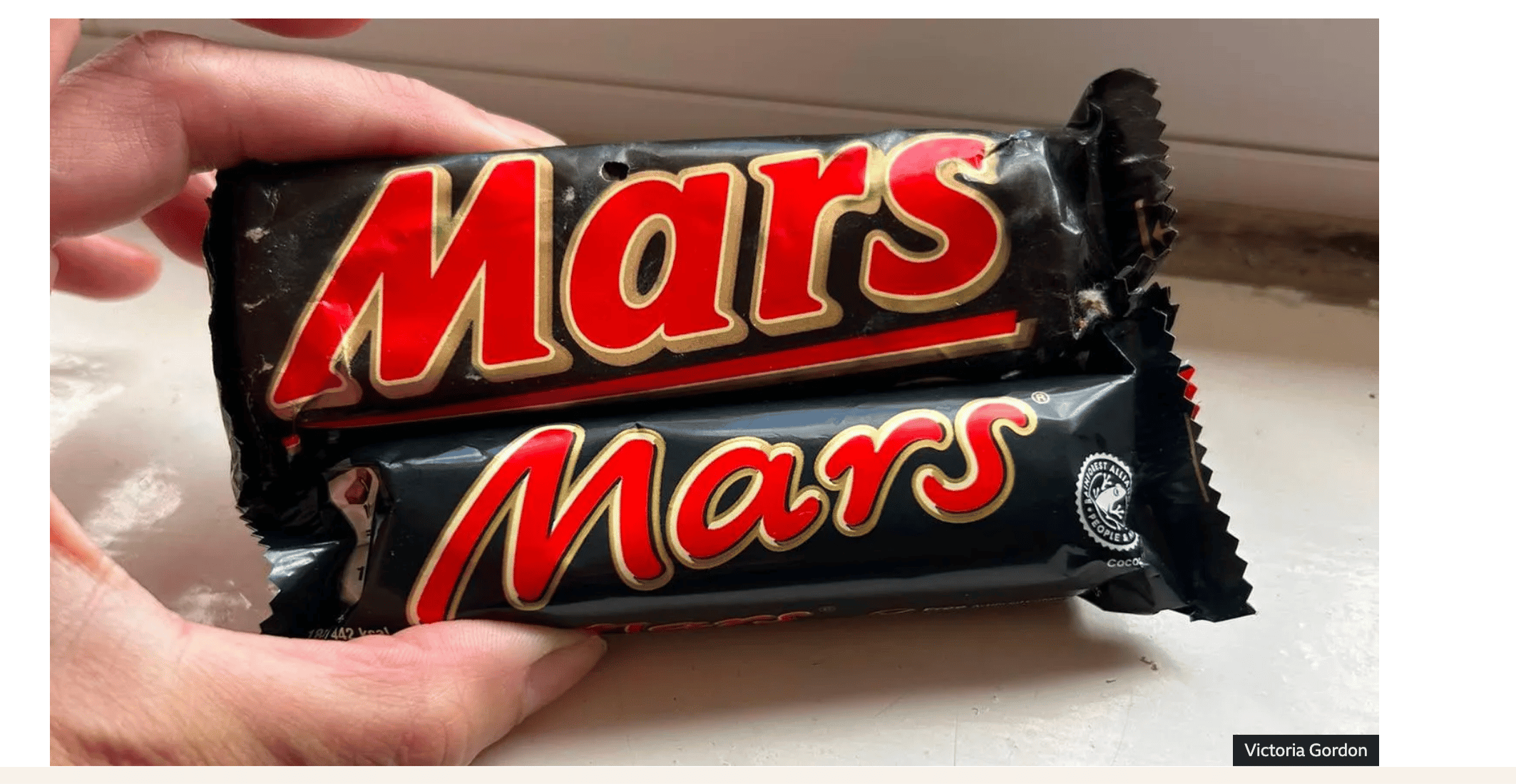
If you sell software, time your price increase with something the customer actually gets: like a feature they asked for. Then the email you send is about the improvement, and the price increase feels justified.
2. Build in public, but publish the misses
Insight from Demand Curve, inspired by Emily Kramer’s interview with Matt Ratchford.
Building in public used to be a differentiator. In fact, when we were running our audience building course called Unignorable, which was a launching pad for some of the biggest creators in the B2B space today, the “build in public” format was a big part of that toolkit. There was a formula, and it was fairly easy to follow if you had good ideas and the discipline to keep going.
Now everyone and their mother is building in public, so it’s far less effective. It’s become a recipe anyone can run: the milestone screenshot, the ARR chart, the lessons-learned thread. Which is how every growth tactic goes. Someone finds a new way to grow, everyone catches on and rides it for a while, then it gets crowded out and stops working. Build in public is at that point now, which means you need a better angle.
Matt Ratchford’s angle is the misses. As growth marketing lead at Mutiny, he’s been documenting things that don’t go quite as planned, week by week:
- The launch that drove a pile of traffic and moved sign-ups far less.
- The offer he put into the market before checking whether anyone could deliver it.
- The week he let agency and contractor work slide because the launch ate everything.
Emily Kramer points out that the humility is what makes it stick: he includes the misses, it’s specific, it’s unglamorous, and it sounds like a human wrote it.
It’s rare, which is exactly why it works. People build in public to win customers and trust, so admitting mistakes feels like the risky option and posting the wins feels safe. That leaves the other lane wide open. Zig while everyone else zags.
But more than that, this approach builds affinity. People relate to imperfection, to stuff that didn’t quite go as planned. And in a sea of founders patting themselves on the back, misses aren’t just rare, they’re welcome.
Which is good news, because your misses are one of the few things nobody can copy off you. Everything else in a build-in-public post is a format anyone can run. Next post, write up the thing that didn’t work.
3. Make it a ritual to increase satisfaction and sales
Insight from Science Says. This is an old but gold insight from the Frontier, our content library.
If people use your product more than once, you can design a ritual around using it, and they’ll enjoy it more and pay more for it.
The same few steps, every time. Not random gestures. It has to fit how people already use the thing, and it has to make the thing better.
Familiar ones:
- Oreo: twist, lick, dunk in milk.
- Corona: press a fresh lime wedge into the bottle.
- Champagne: pop the cork, cheer, pour into flutes.
Why rituals work:
- A ritual tells people the “right way” to use it.
- It’s a small version of the IKEA effect. If you did part of the work, you value the result more.
- It gets them in the right mindset before they start.
It also turns a mundane moment into an occasion. Popping a cork is how you mark a win. That’s why it feels different from unscrewing a cap.
Elements of a great ritual:
- Easy to do. If it’s hard, people won’t do it.
- Tied to an emotion. Celebration for champagne. Relaxing for Corona and lime.
- Has a trigger. KitKat built theirs around coffee, because drinking coffee is already something people do every day.
- Adds to the experience. Corona on its own is kinda meh. Add the lime and suddenly you’re on vacation.
Once you have an idea and an emotion to tie it to, test it on a small scale. Then show the ritual next to the feeling you want attached to it. Lime in the Corona, someone on a beach in Mexico.
Done right, the ritual becomes the reason people reach for you instead of the identical thing sitting next to it.

News you can use
- Reddit's share of ChatGPT citations fell 86% in four days. Promptwatch tracked it going from 3.83% of ChatGPT Search citations through early August to 0.52% between Aug. 14 and 17, though they can't say why and can't rule out a problem with their own data collection. Either way, if seeding Reddit is most of your AI search strategy, that's a lot riding on a source you don't own. (Search Engine Land)
- LinkedIn says AI slop is losing reach. More than a million people used the new "seems like AI slop" button in its first two weeks, and LinkedIn says posts it classifies that way are getting 40% fewer views than a few weeks ago. Their definition: polished presentation, nothing behind it. (Social Media Today)
- Microsoft Ads drops Max CPC on Oct. 1. New campaigns on standalone Maximize Conversions, Maximize Conversion Value, and Maximize Clicks lose it, while existing campaigns and portfolio strategies keep it. Microsoft is telling advertisers to test without it now, which beats finding out in Q4. (Search Engine Land)
Avoid shrinkflation, what to do when building in public stops working, and how to make your product a ritual.
How to increase desire, why Bezos picked books, exclude your refunders.
1. Say what it does, then say it with style
Insight from Joey Noble and Devon Reynolds of Demand Curve.
Devon and I work on a lot of the same DC accounts, mostly through our landing pages and story system work. One framework keeps coming back up whenever we're using copy to lift conversion:
Conversion = Desire - Labor - Confusion
People convert when they want the outcome badly enough (high desire), don't feel like getting it takes too much work (low labor), and understand what they're getting (low confusion). There are more variables in reality, but as a way to think about maximizing conversion on a page, it holds up.
Labor and confusion are the easy ones to spot. Desire is trickier, and we think it's the most important of the three. Most conversion advice is about removing friction, which is just another way of saying labor and confusion. That work is worth doing. But if people don't want the thing in the first place, a perfect page won't save you. And if they really want it, you can get plenty wrong and still get the sale. Raise desire and the returns dwarf anything you'll get from cutting a form field.
So that's where we spend our time with clients, and the first move is always the same. Make the outcome easy to picture. It's hard to want something you can't see.
Which means a concrete outcome instead of a vague promise. Most pages start somewhere like this:
- A fitness app: "Unlock your potential."
- A productivity tool: "Work smarter."
- A music player: "The ultimate music experience."
These starting points are too abstract. You can't picture unlocking your potential, and you can't measure working smarter.
Compare that to Apple's "1,000 songs in your pocket." "1,000" is specific and measurable. "Songs" tells you exactly what you get. "In your pocket" is a physical image you can picture.
This relates to what psychologists call the concreteness effect. Concrete information is easier to understand and remember than abstract information, because people can form a mental representation of it. Which means they can picture themselves getting the outcome before they've clicked anything.
Here's the order I use. Say the outcome plainly first, before you try to make it sound good. Plainly, it's something like "carry your entire music library with you." That's more useful than "the ultimate music experience," because it names what you get. Then you go find the sharper version, which in Apple's case was "1,000 songs in your pocket."
Style can make a specific promise memorable, but it can't make a vague promise specific. So say what it does first, then rewrite it with style.
A few more, same two steps:
- "Take control of your inbox" becomes "Get to an empty inbox before lunch."
- "Streamline your workflow" becomes "See who's blocking what, on one screen."
- "Simplify your finances" becomes "Know your exact runway on the first of every month."
- "Best-in-class support" becomes "A real person replies in under five minutes."
Obviously, your specific promise needs to be something you can actually deliver on.
Go through your page and mark every promise you can't picture. Write the flat version of each one underneath it, then sharpen from there.
2. Choose the category your advantage is worth most in
Insight from Nick Costelloe of Demand Curve, inspired by Jeff Bezos at the 1997 Special Libraries Conference.
I’m not a fan of Jeff Bezos. But I do a lot of marketing research, so I came across this fascinating 1997 talk with a lesson that stuck.
Some quick context. In 1994 Bezos was working at a quantitative hedge fund in New York when he found the number that started Amazon: web usage growing at 2,300% a year. He wrote out a list of about 20 products you could sell online. Then … he picked one.
Why books? Because of a structural fact about the category: there were more than 3 million books in print worldwide at the time. Music was the runner-up, at about 200,000 active CDs. No physical store could hold a meaningful fraction of 3 million. As he put it, that many items lets you build a store online that couldn't exist any other way.
Here's what I found most interesting. Choosing what to sell is a growth decision.
It's a great example of product-channel fit. The Five Fits splits your business into the parts you can engineer and the parts you can't. Product, model, and story are yours. Market and channel are not. So the job is to shape what you control around what you don't.
Most of us run that backwards. We build a product, then go looking for a channel that will work for it. Bezos ran it in the right order. He started with the channel, an online store with effectively unlimited shelf space, and worked back to the product that fit it best.
A structural advantage isn't spread evenly across categories. Unlimited shelf space is worth almost nothing where there are a handful of SKUs, and it's enormous where there are 3 million. Books were where that gap between what he could do online and what a physical store could do was widest.
Sure, this is easier to act on if you're starting from zero. But even if you already have a product and a market, you can run the same test on whatever advantage you actually have. If your edge is speed, the category to attack is the one where the incumbent is slowest and customers feel it every week. If your edge is that you can serve a single customer profitably, go where the competition needs a hundred-seat minimum to bother. Instead of focusing only on what you're good at, ask where being good at that thing is worth the most.
3. Exclude the people who look like your refunders
Insight from Prash Brooks, who runs Paid Marketing for Demand Curve clients.
Some of my accounts have been getting a lot of low-quality traffic from Meta lately: bots and buyers who refund and return at high rates.
The old fix was to tighten who you target. That option keeps shrinking, because more spend moves into Advantage+ and Meta decides who sees your ads. Which leaves you with an odd split. You've lost most of your control over who gets in, but you still have all of your control over who stays out.
So I've been steering from the other side. Here's one thing I'd recommend trying if you're noticing high return rates. Build an audience of your existing refunders and returners. Then create a 1% lookalike off it, the people Meta thinks resemble your returners. Add both as exclusions. You're blocking the people who send products back, plus the ones who pattern-match to them.
I've been running this for several years across accounts. My ballpark is around a 5% improvement in ROAS. Not a huge transformation, but this can run in the background of every campaign once it's built.
One tip: keep the seed list small. Between 1,000 and 1,500 people is the range I aim for. Load in every refunder you've ever had and the lookalike comes back noisy and unfocused, which defeats the point.
News you can use
- YouTube now counts a view the moment a video starts playing, on long-form, Shorts, and live. Public counts will climb without anyone watching more, and the old metric stays in Analytics as "Engaged views." The switch is Aug 24, so if you report on video, move your dashboards to engaged views and treat that date as a break in the series. (TechCrunch)
- ChatGPT Ads switched Automatic Advanced Matching on for existing web pixels on Aug 17. It hashes email and phone numbers from your site forms to match more conversions, and it's on now unless you opted out before the deadline. If you're running ChatGPT ads, check Tools > Conversions > Data Source so it's your call and not a default. (Search Engine Roundtable)
- Google's generative AI report in Search Console is reaching a lot more properties, with a pop-up inside Search Console pointing people to it as of Aug 11. Google still says not every property has access. The report splits your impressions in AI Overviews and AI Mode out from regular organic, and there's still no click data, so track AI impressions on their own line instead of reading them like organic. (Search Engine Watch)
How to increase desire, why Bezos picked books, exclude your refunders.
Unoptimized marketing, onboarding friction, and AI search
1. Chubbies founder on the few things that actually moved brand and growth
Insight from Preston Rutherford, co-founder of Chubbies.
Preston Rutherford co-founded Chubbies in 2011 and sold it a decade later for over $100M. Looking back, he says only a handful of things actually made a difference for marketing and growth:
- Content for content's sake. They sent an email every Friday with one job: make people laugh. No revenue goal, no product links. People forwarded it to friends, and it turned into an acquisition channel they never planned for.
- Memorable interactions. Funny product names, easter eggs on the site. "5.5-inch inseam khakis with an elastic waistband" became "Khakinators," something easy to tell a friend when they ask about your shorts, and something for people to search.
- Escalating box inserts. Customers got a special gift on the first order. The second was better. The third, better than that. People posted their gifts and asked each other how to unlock the next one. It drove LTV. It also drove new customers.
Here’s his point:
"It's so easy to get into the day-to-day machine of Facebook ads and ROAS and CAC and sending the next batch and blast that we miss the things that truly make the difference... everyone's doing the same stuff, so for the brands who can go in a slightly different direction and create those tiny (or big) special moments, those little wins compound and act as the rising tide that lifts all boats."
Our take: most of this wouldn't survive a modern growth review. It's brand work, and you can't cleanly track it. Which is probably part of why Chubbies worked. When everyone's turning the same dials, and using the same prompts and models, the only thing left to win on is the stuff you can't automate. The human stuff.
2. More or less onboarding friction?
Insight from Gaurav Vohra's Superhuman onboarding playbook.
Superhuman's onboarding gets copied constantly, and the debate is usually about friction. Less or more? Vohra, who built that onboarding, has results pointing both directions:
- They cut the navigation lesson out of self-serve onboarding, teaching only the two keys that produce inbox zero, and activation went from 40% to 50%.
- They turned an optional setup checklist into full-screen panels with no skip button, and completion went from 30% to over 98%, partly because users now had to finish or bounce.
Less friction in one case, more in the other, and both were hits.
The thing both changes share: Superhuman knew exactly one outcome it was pushing every new user toward, an empty inbox, for a specific customer, in under 30 minutes. Once you know that, you can decide when to add friction and when to strip it, all for that one goal.
Vohra's rule is simple: an interruption has to be really valuable, or it's gone. That kills about 90% of what you'd otherwise add. But the rule only works if you know the one goal you're steering people toward. Teams that can't name it just drop in a dismissible tooltip and move on. It's the thing you ship when you haven't decided what onboarding is even for.
Friction isn't good or bad on its own. It all depends on where you're pointing it. We've covered the upside of stripping it with opinionated defaults, as well as when more friction is good. It pays when it's pushing someone toward an outcome you've already committed to, and it's just friction when it isn't.
Before you touch the flow, write the sentence: the one outcome, for the one customer, that your onboarding exists to deliver. If you can't, no tactic downstream is going to rescue it.
3. The information gain problem
Insight from Zach Boyette, Managing Partner @ Saturation.
In AI search, your best-written page can get skipped while a worse one gets cited. Rewriting it won't help, because writing quality isn't what the model is grading.
What it's grading is information gain, an idea Google patented back in 2022. Plain version: how much does your page add that the reader hasn't already seen a hundred times somewhere else?
Old-school search rewards authority and backlinks, so a page that just repeats what everyone else says can still rank. AI answers work differently. For a straight factual question, authority still wins. But for the "what's the best way to handle X" questions your buyers actually type, the citation goes to whoever said something the model hadn't seen before.
So better writing is a dead end here. The move is better inputs.
Here's the trap. Writing about a topic usually starts with researching it. You read the pages already ranking, skim a couple reports, scroll LinkedIn, ask ChatGPT for a summary. Every one of those inputs is already indexed. So your finished page comes out as a remix of stuff the model has read a thousand times, and its information gain rounds to zero.
The way out is to start with stuff that was never published in the first place. Your sales calls. Your own numbers. The real reason your product works the way it does. None of that is on the internet, which makes it the one thing you can say that nobody else can.
Here's how Saturation runs it, in four steps:
- Access. Mine your own sources for insights: The objection your reps answer on every call. How long onboarding really takes by industry. Why the founder built it this way instead of the obvious way. Churn in your customers' actual words.
- Filter. Keep only the claims a competitor couldn't make and you can prove. The test: is it better than the best few pages already covering this? If not, cut it.
- Anchor. Publish the finding as its own thing (a report, a benchmark, a dataset) with the methodology attached, on a URL that doesn't move. Make it the thing people cite, not commentary about it.
- Expand. Point your other content back at that URL, and keep the asset updated so citations stack on one page instead of spiking and fading.
Quick real example. A consumer SaaS came to us getting buried in search and AI results. They assumed they were doing something wrong, that competitors were just out-publishing them. They weren't. They had genuinely unique features and were barely mentioning them anywhere, on their own site or off it. It wasn't a volume problem, it was a story problem. So we sat down with their product team, wrote down what the product actually does that nobody else does, and published it. App downloads rose 109%. Non-branded clicks rose 58%.
You almost certainly have stuff like this lying around too. Having it and actually publishing it are two very different things.
PS for newer readers: Saturation is our sister company. Getting startups cited in AI search is the whole thing they do. If you need some help with it, reach out here.
News you can use
- A US appeals court said AI shopping agents can buy on Amazon. On Aug 4 the Ninth Circuit lifted the court order that had blocked Perplexity's Comet since March, ruling that an agent doing what you told it to is legally you, not the software. The case isn't over, but it removes the main legal tool platforms had for keeping agents out. (The Next Web)
- OpenAI shut down its own browser. Atlas stopped working Aug 9, less than a year in, and agentic browsing moves into the ChatGPT app and a Chrome extension instead. So the fight for AI visibility is happening in the assistant and the extension, not in some new browser you have to win. (9to5Mac)
- Cloudflare will block "mixed-use" AI crawlers on ad pages by default starting Sept 15, and it's moving to pay-per-use. Plainly: the open web is starting to charge AI for access. If your growth plan leans on free traffic from AI answers, the crawling that feeds those answers is getting priced right now, so take a position before the deadline. (TechCrunch)
Unoptimized marketing, onboarding friction, and AI search
We've got some updates
1. How Joey audits a landing page
Insight from Joey Noble of Demand Curve.
After reviewing literally hundreds of client pages, I check the same seven things. They don’t all matter equally, but together they tell me whether a page is actually doing its job. Ranked by how much they move conversion:
- Clarity. Can someone grasp the offer in five seconds? What is it, who’s it for, why care, what next? Is there one obvious primary action? No jargon unless your market genuinely speaks it.
- Intent. Does the page match the visitor’s traffic source and awareness level? If a cold social ad sends problem-aware people, pick up the story where the ad left off instead of jumping three steps ahead. Branded search, retargeting, and comparison traffic all arrive warmer.
- Value. Is the outcome concrete and desirable? People buy the quarter-inch hole, not the drill. “Book 30% more qualified calls” beats “AI-powered outbound automation.”
- Proof. Is there specific evidence next to every big claim? A real case study (who, what changed, by how much) beats five stars from an anonymous “verified buyer.” The bigger the claim, the stronger the proof needs to be.
- Friction. What adds effort, doubt, or distraction? Nav links that lead off the page, value props buried in tabs, walls of text, an unclear price, a CTA that feels like a huge commitment. I flag these and remove them.
- Differentiation. Could your closest competitor put your headline on their page without lying? If so, it’s describing your category, not you. “Save time” and “built for modern teams” both fail. More on benefits vs. value props here.
- Momentum. Does each section answer the next question in the visitor’s head and push toward the action, in sequence, instead of jumping around?
Nail clarity first. A perfectly sequenced page won’t work if nobody understands what you do.
This is one lens I run on client landing pages. You can try it yourself. But if you want me to do it for you, reach out here.
2. Your biggest competitor isn’t in your category
Insight from Andrew Chen.
Ask an AI founder who they’re competing with and you’ll likely get a list of AI companies. But here’s what Andrew Chen actually thinks they’re up against:
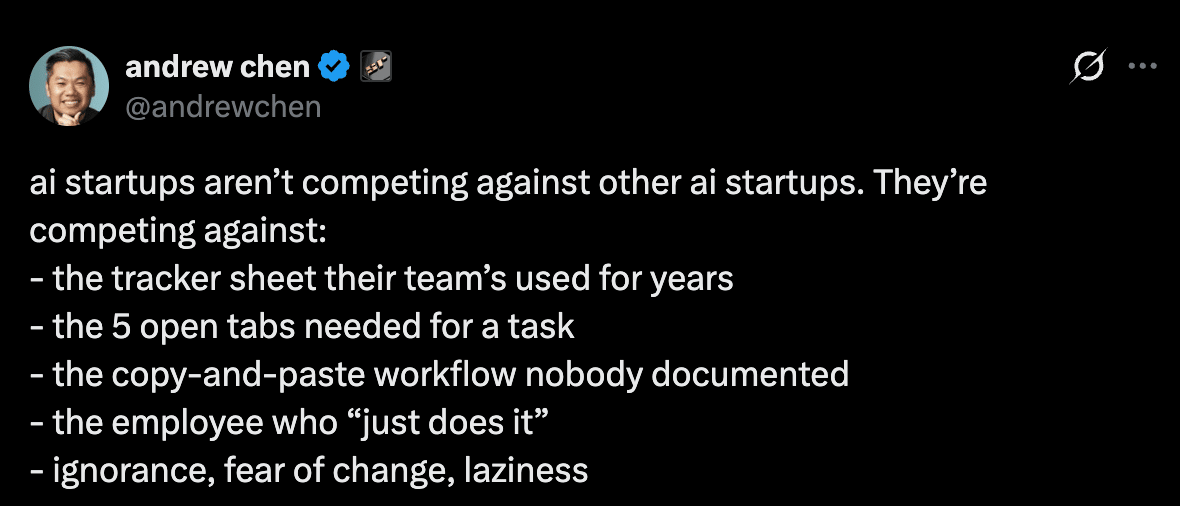
Put another way, companies are also competing with the status quo: how people are spending time, how they’re spending money, how they’re currently doing things.
It’s a good instinct to prioritize the customers who are already in market. Those people already decided they want to solve the problem. They’re high intent. But don’t mistake it for the easier bucket, because every competitor you have is fighting over it, and it’s expensive.
The bigger pool is everyone who hasn’t started looking at all. Convert them at a worse rate and you can still come out ahead per dollar.
So what’s working just well enough for the people in your market? Those are your competitors.
Talk to your customers and find out what actually broke right before they went looking. Three questions in a post-purchase survey gets you this. Ask the people still on the workaround what they like about it, too.
Then you can figure out what that workaround was really costing them. Hours, mistakes, one person holding knowledge nobody else has. That’s what you position against, instead of somebody’s feature grid. So write a landing page for the person who isn’t shopping. “Better than [competitor]” only lands on someone already comparing. “Still tracking this in a spreadsheet?” lands on everyone who isn’t.
Anthropic’s hard questions ad, however controversial, is actually a good example of this in practice. It highlights people asking whether AI can be trusted, who gets to decide the rules, whether it makes the world more dangerous. No competitors named. The ad isn’t for anybody deciding between Claude and ChatGPT. It’s mostly for the people who aren’t using AI, and/or those who are skeptical of it. That’s a huge audience.
Your category is the small pool, and most of the room for growth is outside it.
3. Take a great insight, make it deliberately messy
Insight from Nick Costelloe of Demand Curve.
It used to be enough to have sharp insight. Something novel, contrarian, spiky. Then share it in a punchy, deliberate way. That was the recipe, and we built this newsletter on it.
Now there’s a new variable “quietly killing” your content. ~ gasp 😂 ~
Cassandra Naji’s post last week hit me, and it’s worth reading in full. She can spot AI-written content in seconds, mostly from the fake drama. “This quietly kills your pipeline.” “Silent failure.” She calls it tension cosplay, and says the manufactured drama is usually cover for insight that’s…not that great.
The part that stuck was the first bit—she spotted it in seconds. (Yeah, that’s right. I’m reclaiming the em dash. AI took it from me and I want it back.)
I’ve got the same detector, and so does anyone who’s written for a living since before ChatGPT. The moment I notice AI writing, my whole lens changes. I decide the writer’s lazy, the ideas will be dull, and I start thinking about the consensus machine and how AI converges on the mean. I came here for the edges. So I bounce.
Here’s the messy part: everyone’s detector is calibrated differently. There are obvious tells. “Quietly.” (So sick of this one.) “It’s not X, it’s Y.” But mostly it’s fuzzier than that. I’ve written things completely from scratch and been accused of using AI. The way I used to write, sharp insights and all, is pretty close to how Claude writes for engagement.
So over the last two years I changed how I write. More mess, more personal stories, the occasional deliberate ramble. Fewer punchy one-liners. Drama only when it’s earned. All of it so it sounds like a person wrote it, because I did.
I didn’t want to change. But an idea only travels as far as it gets read, and the second someone smells AI you’re the writing equivalent of a Cybertruck on the road. People get mad or they ignore you. Either way, you lose.
I still use AI often. Research, outlines, pressure-testing an argument. My voice is the one thing I won’t outsource. When everyone runs the same tools and the same prompts, everyone lands on the same mean, and voice is what’s left. That’s the moat.
So: start with a great insight, add personality, and please, make it messy.
News you can use
- 41% of long-form LinkedIn posts are likely AI-written, per detection service Pangram, and 30% of short ones. LinkedIn’s answer is a “Seems like AI slop” option in the three-dot menu on posts and comments, which hides whatever you flag. It’s also retiring “enhance your post” and replacing it with a proofreader that fixes grammar without touching your voice. (404 Media)
- OpenAI appears to be building ChatGPT ads that open an AI agent instead of a webpage. Tapping one would start a conversation built from your site and product feed, making the chat the destination rather than a click-through. Nothing announced yet. We already run ChatGPT ads for clients, so talk to us if you want a head start on this one. (Search Engine Land)
- Reddit is testing a “video Reddit” you can watch or just listen to. On the Q2 call, CEO Steve Huffman said it’ll turn popular posts into background video and audio, TikTok-style. Worth watching if Reddit is a channel for you, since it’s one more place your posts get consumed without anyone clicking through. (TechCrunch)
We've got some updates
How breakout companies actually pull away
Picture two companies. They share the same fundamentals, same market, same starting capital. Five years in, one has built a solid business: steady revenue growth, approaching profitability, a happy customer base. The other is on pace to be the fastest-growing company the category has ever seen.
The usual explanations don't hold up here. Product-market fit doesn't explain it, because both companies have it. Luck could play a role. But only up to a point.
Something else is going on. An X-factor of some kind. Or, as we like to call it, a growth catalyst.
Foundations explain a lot, but not the outliers
A strong foundation, which we usually talk about as alignment across your Foundational Five, explains why you grow. The ease/difficulty in which you'll grow. It doesn't explain why a few companies grow at a completely different order of magnitude.
That's where growth catalysts come in: structural or situational advantages that wrap around your foundation and accelerate everything they touch. They help to explain how two companies with similar fundamentals end up in totally different places, and why a rare few end up setting growth records.
Catalysts split into two buckets:
- Flywheels are self-reinforcing. Each turn makes the next one cheaper or faster, so growth compounds instead of flattening out.
- Boosters aren't self-reinforcing. They give you a real edge, but lack the defensibility of a flywheel.
We went deep on flywheels a few months back in Growth Newsletter #307, so I won't run it all back here. The short version: they're the big enchilada of growth catalysts. The biggest growth driver of them all. But they're also rare and require enormous investments to get spinning. Boosters, on the other hand, tend to be more accessible.
The boosters worth looking for
Market boosters. Being early to a market before it's obvious.
The most common version is an underserved market. Nobody's serving a group of people well, you show up, and for a while you're the only real option.
The catch with market boosters is the expiration date. The moment competitors clock the same shift, things get crowded quickly.
An underserved market catalyst is no different. Yes, it may be a catalyst today, but it's not inherently defensible. If others rush in once they realize your insight, then your catalyst is going to be diminished, if not entirely wiped out.
The next market catalyst is regulatory or cultural shifts. For example, spotting a regulatory change that opens up a market that used to be closed. Very similar to the underserved catalyst in that you are, at least for some moment of time, playing in a blue ocean.
Product boosters. When distribution is built into the natural usage of the product.
The most common version is user-generated content, or what I'd more broadly call user-generated artifacts. Notion is the classic case. Users built templates, published them, and did the marketing for free. Templates were onboarding, content, and a small switching cost for whoever made them, all at once.
Real quick, it's worth clarifying why this is a booster and not a flywheel: The core product doesn't get better as more people join. Only the distribution does. i.e. product-led growth and network effects are not one and the same.
Then there's IRL virality, which people forget about because there's no share button involved. Lime scooters, for example. People saw them around their city, saw other people riding them, and asked what they were. The product did the advertising by existing in public.
Model boosters. These emerge when your business model lets you offer something rivals can't afford to match. One of the most well-known (and effective) is being the only player in a market with a free offer.
Take Robinhood. Every other broker charged ~$5 a trade because they had branches, brokers and legacy infrastructure to support. Robinhood's model didn't, so it could run at zero and still make money. For years, that was their edge. Until it wasn't. In late 2019 Schwab went to zero, and within days basically the entire industry followed.
That's boosters for ya: high impact, low defensibility. Free only counts as a catalyst when you're the only one offering it. The moment a rival matches your model, the edge is gone.
Brand boosters. This is where it gets fun. These live in how people see you: a story or a stance a competitor can't copy without hurting itself.
Dollar Shave Club versus Gillette is textbook. DSC built a cheap, irreverent, direct-to-consumer subscription. Gillette held off from copying it for years, because matching that price would have torched their premium positioning and matching that model would have damaged their relationships with retailers.
Then they watched DSC take enough market share that they caved anyway. Gillette launched its own subscription club in 2015, then cut blade prices around 12% in 2017, the first legit price cut in the company's history. And it hurt. The cuts dragged on sales, and P&G eventually wrote down Gillette by $8 billion.
That's counter-positioning working exactly as designed. The incumbent is stuck both ways: damaged if they don't respond, damaged if they do. To capture it, build the thing your incumbent can't match without hurting itself.
Founder story and category creation live in this same bucket. A known founder buys trust nobody else can fake. Owning a brand-new category buys you your own little monopoly, at least until someone else rides your coattails.
Channel boosters. These are the most underrated of the bunch, and they're not really about being first to TikTok. That's the small version. The big ones:
A whole new distribution platform emerging. The internet created search and banner ads. Mobile created social ads. Right now it's LLMs, and that window is open while you're reading this. The companies that figure out how to get found inside AI answers over the next two years will look, in hindsight, like the ones who figured out SEO in 2005.
AI search is unusual because it's two things at once. It's a fundamentally new distribution platform. But it also looks like one of the rare channels that compounds: the position you build now gets harder for a competitor to take from you later, the same way early SEO positions did. That combination is why we've been putting real weight behind it, and it's the whole reason we built Saturation, our AI search agency.
Platform and ecosystem access. Third parties build on top of you and bring their audiences with them. e.g. Shopify's App Store.
Exclusive audience access. You own a large audience you can reach whenever you want, or you have privileged access to a market that's closed to most operators.
An ignored or under-executed channel. Sometimes a space that looks like a red ocean begins to look pretty juicy when you realize the incumbents are all duking it out on the same channel when there's another way to reach the same market.
Company boosters. An elite founding team. Privileged network access (usually because of said founding team). And access to outsized capital. Those are the biggies. Not exactly things you can just snap your fingers and create. But they are catalysts. And if they're present in your company, leveraging them should be a focal point of your growth strategy.
Where to start
There's a lot written about engineering catalysts and moats into your company, and our advice here is simpler than that.
Every company has its own DNA. That's what the Foundational Five is really for. Your market, product, brand, model and channel constrain each other, and together they set the limits on what's viable at the strategy and execution layer. Catalysts work the same way. Given your DNA, only a handful will ever be available to you, and no amount of wanting one changes that.
So don't start by building. Start by assessing.
And when you find a candidate, check the conditions before you get excited. A free tier isn't a catalyst if two competitors already have one. An underserved market isn't a catalyst if you're the third one to notice. An under-executed channel is only a catalyst if you have the expertise to outexecute.
Maybe you have an existing booster. A founder with a sizable social following, for example. But is your growth strategy built to fully leverage it? We see plenty of "influencer" founders who go months at a time neglecting their sole advantage because they're so focused on building the rest of the business. If you have a catalyst and it isn't the cornerstone of your strategy, it's time to reset.
Most founders come up empty on that first pass. Completely normal. The bigger question is what comes next: what would have to fundamentally change for a catalyst to exist a year from now?
Wrapping up
Great fundamentals get you into the game. A catalyst is why some companies break out and stop playing the same game as everyone else.
(I know, cheesy ending. Couldn't help myself.)
If you have any questions about identifying or leveraging catalysts for your company, shoot us a note. Otherwise, that's all for today!
How breakout companies actually pull away
Paid marketing is largely won or lost off-channel
A couple of years ago, I was casually advising a founder friend who runs a DTC skincare brand. One day, she came to me because her investors were pushing the company to launch Meta Ads and wanted a second opinion.
I cautioned her against it for one simple reason: their unit economics couldn't support it. Given their contribution margin, cash balance, and payback requirements at the time, they would've needed a CAC under $15. For an early-stage, unknown brand in their category, that just wasn't in the cards.
But, as it tends to happen, the investor pressure won. They found an agency that was all too happy to lock them into a six-month contract. $100,000 of spend later, the agency delivered its conclusion: Meta Ads isn't right for them.
The agency got it half right. Paid marketing didn't work for them (no shit). But not for the reasons anyone was looking at. Turned out, it wasn't a channel problem. It was everything outside of the channel that was wrong.
Everyone's trying to “crack” the channel
“We've gotta find product-market fit first. Then we'll test some channels and figure out growth.”
(I made this quote up. But far too many founders have said some version of this at some point in their career.)
Most startups treat paid channels, and really customer acquisition as a whole, like a puzzle to be solved. With enough experimentation, trial and error, and brute force, eventually the channel cracks and the floodgates open. And if one channel doesn't crack, you just move to the next one and keep trying until you find the magical recipe.
Here's what that mentality misses. At the highest level, there are only a handful of ways to scale customer acquisition. And for any individual company, only a slice of those are viable, because viability is dictated by the DNA of the business: its product, its model, its market. So the company that quits paid after a short test is usually pulling the plug on one of the only motions available to it, then wandering into lanes that are fundamentally misaligned with its business.
So where does the “crack the channel” approach come from?
Start with the classic startup teachings. Founders are taught that product-market fit is everything: nail PMF, and growth takes care of itself. Take your product-market fit to a marketing channel and open the floodgates. So growth gets bolted on in the ninth inning instead of engineered into the core of the business from day one.
Second, it feels safer. A startup that spent months or years iterating its way toward product-market fit does not want to hear that the foundation is the problem. It's far easier to blame the channel and work at the channel level: new creatives, new messaging, new landing pages, different levers in the ad platform. Asking whether the fundamentals of your growth system are broken means questioning the product, the model, maybe even the market you spent years building toward. Few volunteer for that.
Those two explain where the approach comes from. Two more explain why it survives.
The brands and thought leaders we all learn from solved their off-channel architecture long ago. That's why they're the leading advertisers. Most of their remaining challenges live on-channel, so on-channel work is all they talk about, and the off-channel work rarely gets passed down to newer operators.
And then there's our industry's dirty little secret: agencies keep the problem alive. Instead of telling a company the honest thing, that its fundamentals can't yet support the channel, most agencies happily sign the client and lock in the contract. The problem that should get nipped in the bud becomes a six-month retainer.
The channel is one part of a bigger system
When most people think about growth, they think about the channels themselves. But if you've been part of the Demand Curve community for a while, you know we view growth as a system, and a channel is only one component of it.
Our Five Fits framework is one of our favorite ways to convey this (quick hat tip to Brian Balfour, whose original Four Fits framework this builds on):
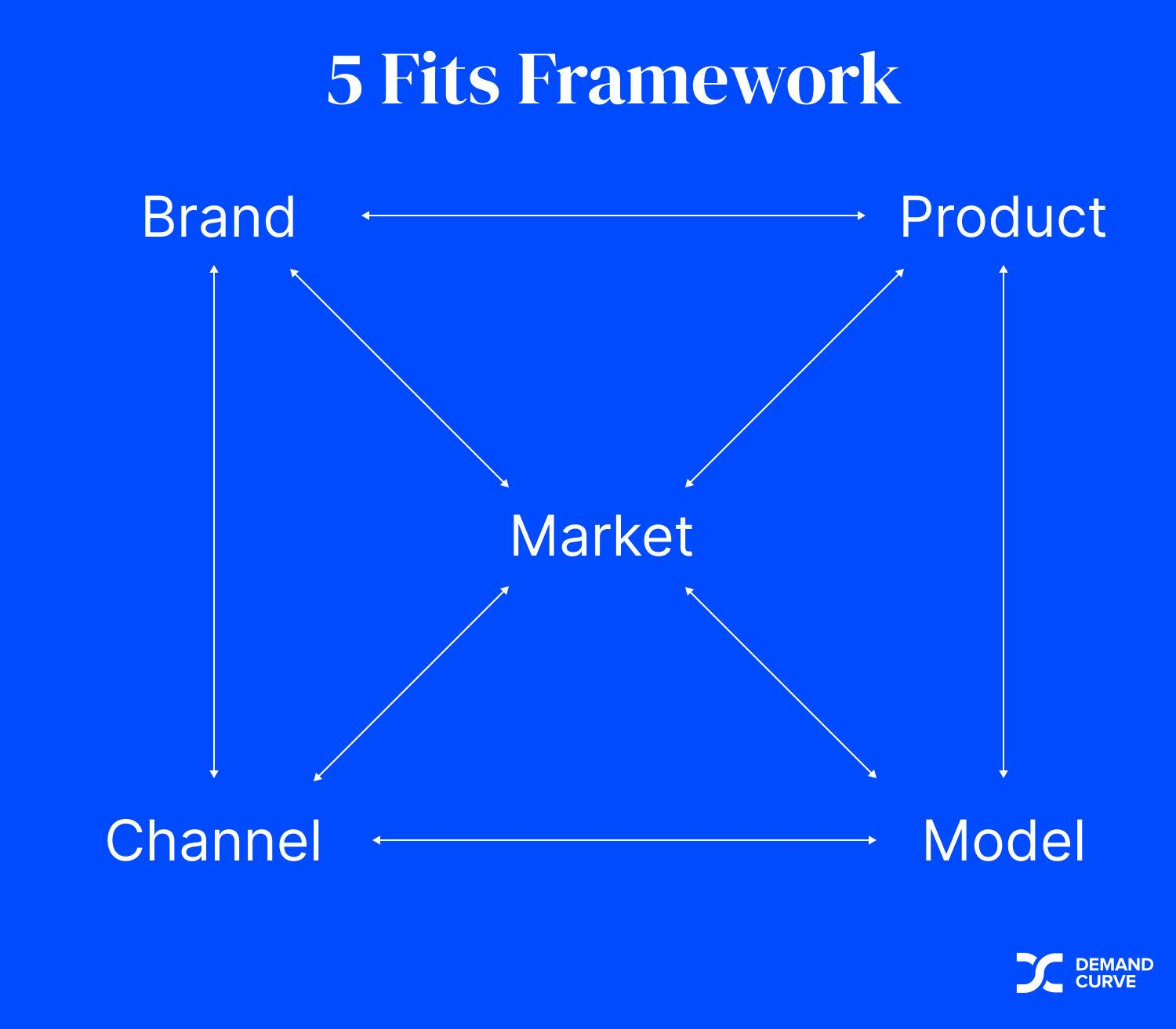
There's a lot to unpack in the framework, but for today it helps us see one big thing: which components of a growth system we control, and which we don't.
You can engineer your product however you want. You can develop any revenue model. You can craft whatever story/brand you can dream up. But you cannot engineer your market, and you cannot engineer the channel. Those two play by their own fixed rules.
Which means the job is to engineer the components you control to fit the ones you don't. For paid, that means engineering your product, model, and story for the channel. Not the other way around.
But the other way around is exactly what most companies attempt. They take a channel made of rules, policies, algorithms, and cultures they do not control, and try to force it to fit the rest of their system.
Let's look at the specific ways these alignment problems show up.
Product-channel misalignment
There's a whole breed of entrepreneur that identifies startup opportunities by reverse engineering from the channel itself. They pick the channel first, then design the entire business, product included, specifically for it.
Most operators do the opposite. They build toward product-market fit in a vacuum, then try to slap a channel on top.
Balfour wrote a fantastic essay on product-channel fit. He outlines the required conditions for a product to be a fit for paid acquisition:
- Quick time-to-value (can someone click an ad and immediately understand the product value?)
- A medium-broad value prop (basically, is this product something a lot of people want?)
- A transactional model (as Brian puts it: the product is built to extract transactional value to fund paid marketing)
I'd add a couple other factors to the list: friction, channel intent, and channel context. People will impulse-buy a $30 t-shirt off a single Instagram ad. Time-to-value is quick (everyone knows what a t-shirt is). That's a component of friction. But so is the price point, and more broadly, the risk. If they end up hating the shirt, they're only out thirty bucks. But that pre-bedtime doomscrolling ritual rarely leads to an insta-purchase of enterprise software or a $4,000 training program. That's a high-friction ask. It also doesn't match the intent and context of the user (i.e. your market) when they're on the channel.
People are on Instagram to unwind after a busy day. A little retail therapy as a prize for surviving Tuesday… that fits the moment perfectly. But asking that same person to sit up and run a SWOT analysis on a purchase decision? I don't know about you, but I'm not a huge fan of homework at 11pm. Especially when a cute cat gif is just one scroll away.
Your model can't afford the channel
One of the most frequent conversations I have with founders goes something like this.
- Founder: “Our target CAC is X. Can you hit that for us?”
- Me: “How was that target established?”
- Founder: “Our investors told us target CAC should be about a third of LTV.”
- Me: “Adjusted for margin?”
- Founder: “No.”
- Me: “Payback period factored in?”
- Founder: “No...”
- Me: “What about current cash balance and cash flow?”
- Founder: “...no.”
The one-third-of-LTV rule is one of those things our industry tosses around as if it were a law of nature. It's fine as a starting point. But as the whole analysis, it's terrible advice. Blindly trusting it can destroy a business. Or it leads a team to conclude paid doesn't work when it might, because nobody did the real growth-finance work: Not just what you can afford to pay for a customer today, but how that math moves as you scale, as audiences get lower-intent, payback stretches, and auctions get more expensive.
Back to that DTC founder. This was exactly the problem I warned about. Investors were pushing an aggressive paid investment, and nobody had run the numbers. $100,000 of wasted spend was entirely preventable. And it was the category of problem you cannot optimize your way out of: channels dictate their own cost realities. You can improve against them, but there are limits, and this math won't fly.
A model story from the other direction: my days at Grammarly. For years, Grammarly was a pay-to-use product, which made it a niche tool for professional writers. It grew profitably with paid media under that model, then hit a plateau. There was a much larger market out there (students and everyday working professionals) that we couldn't reach affordably with paid, because of the model itself. Casual writers weren't going to put a credit card down for a writing tool.
Freemium changed what the channel could do. The offer became dramatically more powerful (“use Grammarly for free”), and that massive casual segment could now experience the value with zero friction. Paid media went from capped to compounding. And here's the part worth sitting with: nothing changed at the channel level. Same team, same systems, same sophistication on the ads. The difference was the model.
You're not reading the room
When I was thinking about how to explain this last concept, it took me back to a cruise my family took one summer. I don't know if cruises still do this, but back then they'd seat you at a huge dinner table with a bunch of strangers. And as one does in that awkward social setting, the table started making small talk: so, what do you all do for work?
I started chuckling to myself, because I could see my parents squirming as their turn got closer. They were both high school teachers, and they'd told me how this goes. The moment teenagers find out, the mood dies. One second they're fellow vacationers, the next they're school authority figures, and definitely not people you can comfortably shoot the shit with on summer break. Sure enough, the teens at the table spent the rest of dinner acting like they were in class.
My parents understood something a lot of marketers never learn: read the room. A summer table full of teenagers is not the moment to introduce yourself as a teacher. Yet marketers show up to social settings and deliver that exact mood-killing introduction every single day.
B2B companies are the worst offenders. They show up on TikTok, Instagram, and Reddit, where people are there to unwind, explore their interests, and socialize, and they arrive armed with corporate lingo, stock photography, and buzzwords. Then they're shocked when they get flamed in the comments or ignored entirely.
Same mistake as the dinner table. The channel has a culture and a context, and you don't control either. This is also where rigid brand guidelines sabotage paid performance: refusing to adapt to channel-native formats is optimizing for a look instead of the room you're standing in. The winners keep their brand's DNA recognizable and let the surface adapt to each channel's culture. (That's what “story” means here: adapting your message to the channel's culture. It's a different job from deep brand narrative work.)
Sometimes it really is the channel
To be clear: sometimes the channel is the weak link, and the system around it is aligned. We see this often with our clients.
Sometimes a team has all the right ingredients but lacks sophistication in creative experimentation. Sometimes they're making genuine mistakes in account and campaign architecture. And one we see constantly: training the algorithm on the wrong conversion event. Most companies default to optimizing for the event they care about most, usually a purchase or a lead. But if that event is too rare for the budget, the algorithm never gets enough conversions to learn from. Swing to a high-frequency event instead, and it can be too far removed from real intent, so the algorithm optimizes toward the wrong people. Custom and proxy events exist precisely to strike the balance between event volume and closeness to real purchase intent. Few teams use them.
And sometimes the ads are fine and the measurement is lying. We had a company come to us for an audit convinced they were crushing it with paid. We had to burst their bubble: they were double-counting purchases. They were planning their Series B on performance data inflated by 2x.
So no, the point is not that the channel doesn't matter. Channel sophistication matters as much as the off-channel architecture. The system needs every piece. But for the vast majority of startups struggling with paid marketing, and with customer acquisition as a whole, the channel is getting the blame, and all the attention, while the off-channel pieces sit misaligned.
It's why we run an audit before starting paid with any client, and why we turn away companies whose systems can't support the channel they want to run. No amount of account work fixes a model that can't afford its own CAC, a story that fights the channel's culture, or a market that was never mapped in the first place.
The next time paid disappoints, skip the question of why the ads underperformed. Ask what would have to be true about your product, model, and story for this channel to work at all.
Alrighty, that's all for today, folks. Until next week!
— Justin
Demand Curve Co-Founder & CEO
Paid marketing is largely won or lost off-channel
The tie you don't know you're in
Insights from Devon Reynolds, Growth Strategist @ Demand Curve
A buyer is choosing between you and your closest competitor. Your product is stronger. Your customers say so and the review sites back them up. On paper, a layup.
Then the buyer reads both websites:
- Yours says "Save 10 hours a week." So does theirs.
- Yours says "All in one place." So does theirs.
- Yours says "Trusted by fast-growing teams." So does theirs.
The buyer scrolls both, nods twice, and opens a spreadsheet to compare prices. The deal you thought was a product comparison is, to them, a coin flip.
And coin flips get settled by whatever still separates the options. Mostly familiarity and price. The more familiar brand usually wins the tie; when familiarity is even, the cheaper option tends to.
A benefit is not a reason
So why does the stronger product keep getting into this mess?
Because those claims ("save time," "all in one," "built for scale") are benefits. They describe what the customer gets, and they're true of the entire category. A value prop answers a harder question: out of every option available, why you?
The difference is ownability. "Built for scale" is a sentence any company can type. ClickUp's "One app to replace them all" was a jab at category fragmentation that only ClickUp could credibly throw, because ClickUp had actually built the "everything-app" to back it.
Yet most startups don't have one.
Writing a real value prop means committing to a point of view. In public. One that maybe not everyone agrees with. And committing is scary.
Mirroring the rest of the market feels safer. After all, if the market leader says "save time," repeating it can't be wrong. (It can. It mostly is.) Sameness became the default because mirroring is the safest-feeling move, and because translating what's truly special about your product into words a buyer feels is hard, unglamorous work.
One weak claim infects the whole funnel
If a benefit only costs you one bland sentence, you could live with it. But it doesn't stay contained. Whatever claim sits at the top of your homepage becomes the seed for everything downstream: hooks, ad copy, onboarding emails, the sales deck. Every asset repackages that same core claim for a different stage of the funnel.
Seed a benefit and every downstream asset inherits it. The ad asks "Tired of wasting hours on manual work?" The homepage subhead promises saved time. The onboarding email repeats the promise, this time with an emoji. When the campaign underperforms, the postmortem blames the channel, because no single asset looks broken. So budget moves to a new channel, the same seed gets replanted, and the results repeat.
Meanwhile the coin flips keep landing against you. Buyers who can't tell challengers apart default to the brand they already know, and the challengers left standing get compared on price.
The incumbent can afford to sound average. You can't.
AI industrialized the sameness
Sameness used to spread at human speed. Over the last few years, it got automated.
Regular readers will remember the consensus machine, Justin's name for what AI does to creative work. The short version: tools like ChatGPT work like your phone's autocomplete, scaled up. They predict the most probable next words based on the data they're trained on. For a legal summary or a SQL query, the most probable answer is exactly what you want. Marketing has the opposite job. Copy earns attention by being the least expected thing in the feed, and a probability engine is built to produce the most expected thing.
So ask AI for your value prop and it hands back the statistically safest claim in your category (ten thousand homepages can't be wrong), which is almost always a benefit. And as more of the web gets written by AI, the average these models learn from drifts toward their own output. Founders across a category run positioning through the same tools, pull from the same shrinking pool of safe language, and land on the same words at the same time.
The dangerous part is how finished it feels. The copy comes back fast and sounds confident. Nothing about it warns you that the competitor two tabs over got the same sentence.
To be clear: AI is a strong fit for plenty of marketing jobs. Point it at research, or at turning one strong message into twenty ad variants, and it earns its keep. Inventing what makes you different is the job it's least built for, and it's the job founders keep handing it.
Three steps to find your value prop
Start with an old gut-check from the positioning world, sometimes called the swap test. Open your homepage and read your value prop out loud. Would it still be true with your closest competitor's name swapped in? If the honest answer is yes, you're holding a benefit.
The swap test only catches impostors, though. Passing it isn't the prize. The fix lives upstream, in the failures your product exists to end. Positioning people will recognize this starting point; April Dunford built a whole practice on studying the alternatives your customers would otherwise settle for. What follows is our compressed, founder-speed version. Three steps:
- List the bad alternatives. Every option your customer uses instead of you: competitors, spreadsheets, a junior hire wearing five hats, doing nothing. For each one, write down the specific failure. Not "it's outdated." What breaks, and when.
- Answer each failure directly. For every bad alternative, write the claim that speaks to that exact failure.
- Keep only what's ownable. Keep the two or three claims that are true of you, hard for your closest competitor to claim honestly, and important to your buyer. Cut the rest, however good they sound.
Run it on an imaginary collaboration tool competing with spreadsheets and email threads. The spreadsheet's failure: two people edit at once and the "real" version becomes a guess. The email thread's failure: decisions get buried three replies deep, usually under a calendar invite.
Answer those failures and you get claims like "never wonder which version is real" and "every decision has a home." Both make the same promise: your team always knows where things stand. Compress that to its sharpest form and you land where Asana landed. One word, clarity, made concrete in a single line: "know who's doing what by when." A competitor could type that sentence tomorrow, but they couldn't back it with the same two named failures, and buyers can feel the difference.
The bad alternative doesn't have to be a competitor, either. For Calendly, it was the fact that scheduling a meeting eats an email thread of its own. Its story has always been the end of that back-and-forth, a claim aimed at a specific, felt annoyance rather than at calendar management in general.
Two survivor stories prove nothing on their own, of course. The reason to trust the exercise is the direction it works in: it starts from your customers' failures and works toward words, instead of starting from words you admire and working backward.
That direction is the real mark of a value prop: it points back to a failure your competitors can't equally claim to solve. If yours points at a problem anyone in the category says they fix, go back to step one. You're still holding a benefit.
Run it yourself, or we'll run it for you
Everything above is the exact problem our Story System fixes.
It’s the same methodology we’ve used to produce results like these:
- Stacker (YC): we rebuilt their story, and homepage conversions doubled, landing pages converted 2.5x better, ad clickthrough rose 22%.
- Perfect Keto: conversions jumped 30% from the messaging rewrite alone.
- Unspun: we handed the custom-fit apparel brand a homepage line no competitor could copy: “We only make jeans in one size. Yours.”
For years this ran as a $30K, six-week engagement. Now it runs at startup speed and startup pricing.
We’re taking five companies in this batch.
The tie you don't know you're in
Insights from Devon Reynolds, Growth Strategist @ Demand Curve
Opinionated defaults, loosely held
Insight from Adam Fishman.
The Airbnb host onboarding experience is a bit magical. You click the CTA in the top navbar that says "Airbnb your home," and instantly, you see this:

Whoa, I could make an extra $2k per month?
To give me this estimate, they had to make a lot of assumptions:
- That my home is where I'm accessing their site from (safe assumption)
- That I can charge $289/night for my place (average based on their data)
- That it has two bedrooms (median number of bedrooms)
- That I'd get 7 booked nights per month (average based on their data?)
- That my home is somewhat "average" and not crazy good or crazy bad (little do they know!)
- That I wanted to rent out my entire place and not just a private room
- That I'm even eligible to Airbnb my home
Some of those things could be horribly horribly wrong. But they committed to reasonable assumptions that allowed me to immediately experience the "magic moment" of seeing how much money I could make.
A bad experience would be making me do a long onboarding form, selecting all of these before seeing my estimate. It would be terrible if I had to enter my email to see my results or, worse yet, book a call with someone to discuss them.
This is the power of opinionated defaults.
Opinionated defaults loosely held
Opinionated defaults are pre-selected choices within your product that nudge users toward desired actions—or that simply make the experience that much easier or more delightful. For example, Airbnb made several opinionated defaults to show me my estimated monthly income.
Defaults are powerful for two reasons:
- They anchor you. If $20 is the default on a donation field, that will be the most common donation.
- They make it smoother for the most common use cases. If chosen properly it can make the experience more seamless for the average user.
"Loosely held" meaning the user can easily change them. For example, I could easily change my location, number of bedrooms, stay type, and number of booked nights to get a more accurate estimate.
You can assume a bunch of different variables:
- Location
- Pricing of users
- Preferred login method
- Preferred payment method
- Template
- Pricing/tier
- More nuanced, product specific things (ex: # of bedrooms)
Let's dive into some more real-world examples:
Uber/Lyft example
Both Uber, Lyft, and Google assume that you're booking a ride or getting directions from your current location:

You can, of course, change this, but it defaults to your current location because 99%+ of rides/navigating likely start there. They've made it more annoying to use 1% of the time to make it easier to use 99% of the time—great trade off.
Patreon example
According to Adam Fishman, Patreon had the problem of all their creators choosing $1 as their support membership price—it just became culturally normal to do it after the default was set to $1—which shows the impact a default can have.
To combat this, they changed the default text to say $1 to $5, which they eventually changed to:

This change significantly increased the average monthly price of tiers—increasing revenue for both them and their users.
Figma example
One thing we've covered previously is Figma's invite and billing mechanism. Most SaaS tools work like this:
- A team member wants to invite someone to the tool so they can collaborate on a project
- But they can't, they need an admin to approve it
- They get delayed waiting for the admin to approve it
- The admin responds 2 days later, saying, "No, we don't want to pay for them!"
- The team member gets annoyed waiting and needs to find a workaround
Here's what Figma does:
- Anyone can invite someone to a Figma file
- New people get added to the team but get the first month for free
- The admin gets an email reminding them of next monthly payment and tells them to check the users
- They go in (maybe) and see their team has added various people
- They either leave them or remove them
Figma made inviting someone to the paid membership the opinionated default. And I imagine that change alone has contributed a lot to their MRR over the years because it's significantly harder for the admin to revoke someone's existing access than denying it in the first place.
Canva example

Templates are a common thing these days. Pushing templates onto people is Canva saying, "Hey, you're probably trying to do something that most other users have already done before; why not use this thing and save hours of work?" In many cases, it works wonderfully—assuming you make templates for the most common use cases and legitimately solve the problem for most people.
Framework for Opinionated Defaults
Adam Fishman made an actionable framework for you. I could reword it for you but this image has all the necessary info.

Just remember, by thoughtfully choosing opinionated defaults, you can guide user behavior to benefit both your customers and your startup, leading to sustainable growth and a more intuitive product. But always, ALWAYS, make sure to let people adapt things how they actually want it in case the default is wrong.
Get going, folks!
Why your signups keep disappearing
Here's something we see constantly. A founder finally gets acquisition working. The ads convert, a post takes off, and signups climb for a few weeks straight. But growth still feels stuck.
So they reach for more of the same: more channels, more spend, more top-of-funnel. Sometimes that's the right call. But once signups are already trickling in and growth still feels stuck, the bottleneck usually isn't the top of the funnel; it's everything that happens after.
What rarely shows up on a dashboard is that a lot of those new signups are already gone. They showed up, poked around, didn't understand the product, and left. And they're not the type to come back. You spent real money acquiring people who quit before they ever saw what your product actually does.
It’s quite common for new consumer apps to lose the vast majority of new signups within the first few months. For some, that can even happen in the first few days.
The part of the funnel that gets underbuilt
It helps to be precise about what "retention" even is, because people throw the word around like it's a single lever. It isn't. It's three different jobs stacked on top of each other: getting users to their first real win (activation), getting them back often enough to form a habit (engagement), and clawing back the ones who drift away (resurrection).
Most companies pour their effort into those last two - the re-engagement nudges, the win-back campaigns, and the cancellation flows. Activation, the part that has to come first, usually gets a welcome email and maybe a tutorial or two. But neither of the other two can happen without activation. You can't build a habit around a value that a user has never felt. And you can't win back someone who never understood the point of you in the first place.
So when activation breaks, the whole back half of your funnel goes with it. You just don't feel it for three months, by which point you've blamed the product, the pricing, the market, and probably yourself.
This is why activation tends to punch above its weight. Lifting the share of signups who hit that first win by 10% will often do more for the business than a 50% jump in raw signups would. And one of those costs money every single month, while the other you fix once and mostly stop paying for.
The moment your product clicks
So what's this "first win"? Every product has a moment where a user flips from skeptical to sold - from "I hope this works" to "oh, that's actually useful." Growth folks usually call it the aha moment; we like "lightbulb moment." Getting crisp on yours is worth more than any onboarding tactic you could copy from someone else. Once you know it, the rest of onboarding is mostly logistics for getting people there faster.
And the rigorous way to find it is in the data: compare the users who stuck around with the ones who bailed, and look for the earliest action that separates them. That's your activation metric, the number you optimize against.
Here's what activation is not. It's not the signup. It's not finishing your setup wizard, and it's certainly not sitting through a boring product tour. Founders fixate on those steps because they're easy to build and easy to measure - completion rates go up and to the right, everyone feels productive. The user, meanwhile, feels nothing. Nobody has ever texted a friend about a great onboarding checklist.
That's actually the test. Your lightbulb moment is the first thing a user would mention to someone else, unprompted - the "you've got to try this" moment. If you can't name it in your own product, I promise your users can't find it either.
Build backwards, not forwards
Once you can name the moment, the move looks obvious: get people there fast. And this is where a lot of teams trip, because the natural way to build an onboarding flow works against you. They build forward.
They start at the signup screen and bolt on steps in the order they think of them. Verify your email. Fill out your profile. Set your preferences. Take the tour. Invite a teammate. Each one seems reasonable on its own. But that's five things a new user has to slog through before your product gives them one good reason to come back.
Flip it around. Start at the lightbulb moment and walk backward. For that moment to happen, what has to be true? And for that to be true, what has to happen right before it? Keep going until you bump into the signup screen. The trail you just traced is your critical path - the steps that have to exist. Everything you didn't trace is optional. And "optional," during onboarding, almost always means cut it, or reveal it later on.
Duolingo does this extremely well. They ask a simple question up front: which language do you want to learn? And then you're translating a real sentence, all before it even asks you to make an account.
Canva runs the same playbook. You’re not dropped into a blank canvas with a basic product tour. You’re immediately asked, "What will you be using Canva for?" and then presented with a template that already looks good, which you change in a couple of clicks. Canva took something that could have been a long, fiddly setup and got people to "wait, I made that?" in barely any time at all.
The moves are always a version of the same idea: swap setup for samples, swap a wall of choices for one good default, swap "assess yourself first" for "just start." Run every step in your flow through a single question - could they reach the lightbulb moment without this? You'll feel a little silly by how much you're making them do for no reason.
Get the friction off the path
Even if you lead people directly to the lightbulb moment, people will still fall off the path. The thing pulling people off it is friction. All the small moments of effort, confusion, or hesitation between signing up and getting value. It rarely shows up as one obvious problem. It shows up as a dozen tiny ones.
It typically shows up in three flavors.
- Cognitive friction is making people think too hard. The field labeled "configure your taxonomy hierarchy" when what you meant was "how do you want to sort your files."
- Emotional friction is making people nervous. "Choose your plan (this can't be changed later)" takes a casual click and makes it feel permanent and risky.
- Interaction friction is just making people grind. Six form fields and an email confirmation before they've done one useful thing, when a single "continue with Google" would've carried them straight in.
None of these kills activation on its own. It’s easy to shrug off as too small to bother with, so it never gets fixed. Do that five times over and you've lost a real share of the users you paid to bring in.
The most common version, and the one I'd fix before anything else, is the empty state. That's what your product looks like to someone who just walked in the door, before any of their data is in it. The whole dashboard is there - the menus, the panels, the charts - they're just all blank. Every number reads zero, every list says "nothing here yet," and somewhere in the middle sits a "Create your first project" button, waiting for them to go fill it all in themselves.
It doesn't look like a problem. Nothing's broken, the thing loaded, the button works. That's why it’s easy to leave alone. But clicking the button was never the hard part. The hard part is everything a new user has to figure out before they're willing to click it.
Picture it from their side. Someone just signed up, which means this is the most motivated they are ever going to be. They have a problem, they went looking, they picked you. Then the product loads, and it's a blank dashboard with a "Create your first project" button and nothing else.
Watch what happens in their head. First, they might think: what do I even make? A project for what? Is this how I'm supposed to use this? They came to you for an answer, and they were handed a blank worksheet at the exact moment they understand your product the least.
Then the feeling, which is the part that actually loses them. A blank screen makes a person feel behind, like everyone else got it and they're the slow one. The bit of hope they showed up with changes to "maybe this isn't for me." Nobody rage-quits an empty dashboard. They just tell themselves they'll set it up later. Then they forget, and later never comes.
That's why this beats every other friction fix on your list. This one costs you people at the peak of their motivation - the single best chance you had to win them. We don’t want to take your best moment with a new user and then make them feel lost.
So don't start them from nothing. Drop them into a realistic example instead - a sample project with real-sounding tasks, a dashboard with believable numbers already in it - so the first thing they see is the product doing its job. Let them poke at it, change it, and delete it once they get the idea. Instead of asking "what are you going to build?", you're showing them what it looks like already built. That's a much easier place to start than a blank page.
If you’re a Notion user, do you remember when you first opened Notion, and you were like, “Uhh, what do I do?” but then you loaded up one of their many templates, and things started to click? That’s what we’re going for too.
The cheapest growth you have
The expensive part is already done. You paid to get these people in the door - the ads, the content, the launch, whatever it took - and they showed up. Then most of them wandered off before the product ever did anything for them. Working on activation is how you collect on money you've already spent.
So before you go buy more traffic, go watch what happens to the traffic you've got. Sign up for your own product with a fresh email and a stopwatch running. Find the moment it clicks - if it clicks at all. Count the steps between the front door and that moment, then start deleting them.
For a lot of companies it's the cheapest growth on the table, and it's been sitting there the whole time, inside a funnel you already built.
If you know a founder busy pouring money into the top of the funnel while the bottom leaks out the back, do them a favor and forward this along.
Thanks y'all!
Why your signups keep disappearing
The paid/organic AI growth loop
Insight from Zach Boyette, Managing Partner @ Saturation
You've now got the mental model for ChatGPT Ads from the first post in the series, as well as a working playbook for campaigns from the second. There's still a piece missing: how all of this connects to the SEO and AI visibility work you're already doing, or should be.
Most startups treat these as two separate motions, without considering whether they should actually be talking to one another.
You probably already know how Google search ads relate to SEO: your ad sits in the paid slot, your page sits in the organic results. Sometimes both show up for the same search, sometimes just one.
AI doesn't split things up that way. Paid and organic presence can land in the same response, for the same person, in the same moment.
Which is exactly why we run both organic AI strategy and ChatGPT Ads for clients at Saturation. What follows comes from watching the two interact in practice, alongside the platform's documentation.
Two different mechanisms
ChatGPT Ads is paid placement, full stop. We covered Answer Independence in Part 2: the ad never changes ChatGPT's organic responses. Two separate systems run on every prompt. One generates the "regular" answer; the other checks the conversation against advertiser Context Hints and decides what sponsored content to show beneath it. The two don't talk to each other.
AEO is the organic side: influencing what the model itself says about you. If you read our previous AI search series, this is that work. Third-party presence, comparison content.
SEO connects to both. AirOps research across 548,000 retrieved pages found that pages ranking #1 on Google get cited by ChatGPT 43.2% of the time, 3.5x the rate of pages ranking beyond the top 20. But getting cited isn't the same as getting recommended. A model can pull your page as a source while naming your competitor in the answer. Rankings get you into the retrieval pool. They don't put you in the consideration set.
Why does the distinction matter? The compounding effect only works once you see that paid and organic are doing different jobs. Paid buys reach and presence in the moment. Organic builds the trust that makes that presence convert once someone actually sees it.
How AEO, SEO, and ChatGPT Ads compound
LLMs build brand-category associations during training. Brands that show up consistently across comparison pages, review sites, and community discussions get baked into the model's consideration set for their category. When someone asks about a problem in that category, the model leans toward surfacing those brands organically.
Now run a ChatGPT Ad against that backdrop. A brand with a strong organic AI presence isn't a stranger to the person clicking the ad. They've already seen it mentioned in the organic response, in an earlier conversation, or maybe a comparison the model pulled together when they were weighing options. The paid placement serves as confirmation. It's reinforcing something the user is already familiar with, not introducing a cold name.
Flip it around and the same ad has a much harder job. For a brand with weak organic presence, that ad is the first touchpoint. It's working without any of the trust organic visibility would have built. Run the identical campaign, identical bid, identical Context Hint against both situations and you'll get two different outcomes. We see this consistently across client accounts at Saturation. The same setup performs very differently depending on whether organic AI presence already exists underneath it.
The relationship runs the other way too. We covered in Part 2 how early estimates put roughly 60% of conversions from ChatGPT ads outside the click window. People see the ad, finish their conversation, and come back later through branded search or direct visits. That behavior feeds the ecosystem the models learn from. More branded search, more people checking you out, more reviews and mentions and third-party coverage accumulating over time. Retrieval systems pick that up within days. The model's baked-in knowledge catches up over the following training cycles. Paid activity ends up accelerating the exact brand association organic visibility is trying to build.
Put both directions together and you get a loop, not two separate efforts. Organic presence improves how paid converts. Paid activity builds the signals organic visibility runs on.
Your ad account doubles as a research tool
In Part 2, we said the most valuable output of a first ChatGPT Ads test isn't conversions. It's impression delivery across your Context Hint variations, which tells you which buyer conversations your category lives in. Look at what that data actually is: a map of the situations where AI surfaces your category. That's the intelligence your organic AI strategy needs, and there's nowhere else to get it. No "AEO tool" shows you which AI conversations your category appears in. Your ChatGPT Ads account is currently the closest thing to that data that exists.
So use it both ways. Context Hints that pull strong impression delivery are the problem-states to build comparison pages and use-case content around. You have paid confirmation those conversations exist at volume. Hints that deliver nothing tell you either the conversation volume isn't there or your framing of the buyer's situation is off. Both are worth knowing before you commission a content roadmap built on gut feel.
This is the cheapest market research you can get right now, and it's a side effect of a channel you should be testing anyway.
Where SEO fits, and what you might already have
If you've put real work into SEO, you're probably closer to having organic AI presence than you'd guess.
Comparison content is the most effective format for both Google SEO and organic AI visibility, with one wrinkle. A March 2026 study from Wix Studio's AI Search Lab found that for commercial-intent queries, listicle-style comparison content captures roughly 40% of citations, nearly double any other format. But third-party comparisons dominate self-published ones: in professional services, 80.9% of cited list content came from neutral third parties versus 19.1% from brands ranking themselves. Your own comparison pages matter. Someone else's comparison page that includes you matters more. Either way, a site with solid comparison and use-case content isn't just sitting on SEO equity. It's sitting on a whole bunch of LLM equity that hasn't been tapped yet.
The part SEO usually doesn't touch is everything outside your own site. We spent a full article on this in the AI search series: the bulk of what models say about a brand comes from third-party sources. Review platforms, Reddit, industry publications, community mentions. That's the layer SEO alone doesn't reach. And it matters more right now than it did a month ago...
On May 7, two days after the self-serve Ads Manager opened, ChatGPT started embedding brand homepage links inline in its answers, in what Profound dubbed the Branded Link Update. The numbers moved immediately. Qwairy's analysis of 140,000+ ChatGPT answers found inline brand links jumped from 0.4% of responses to 6.2% in a single day. That's a 14x increase, specific to ChatGPT, while Perplexity and Gemini stayed flat.
Profound's tracking across monitored brand sites shows daily referral traffic rose ~60-65% and held. And the gains weren't even: B2B SaaS referrals rose over 200% from baseline, fintech around 60%, while ecommerce stayed flat. ChatGPT routes retail recommendations through its separate shopping surface, which didn't get the link treatment.
Note the timing. In the same week, OpenAI opened paid placement to everyone and made organic mentions clickable. They're building both halves of the click economy at once. Being part of the organic conversation now converts into attributable traffic in a way it didn't a few weeks ago. Similarweb measured ChatGPT referrals converting at 7.1%, just behind paid search at 7.8%.
So before building anything new, audit what's already there. Comparison and use-case pages may already be generating AI citations nobody's checked for. The gap is more likely sitting in third-party presence than on-site content. With organic mentions converting to clicks more directly now, closing that gap is worth more than it was before May 7.
How to sequence ChatGPT Ads with AEO
A big question founders are asking us at Saturation is whether to start with organic AI visibility or ChatGPT Ads. And it depends on where you're starting from.
Say your organic AI presence is minimal. Run the visibility audit first, the one we walked through in Part 1 of the AI search series. An hour of asking the questions your buyers actually ask, across the major models, tells you whether you're dealing with invisibility or misrepresentation. Those are different problems with different fixes. Either way, go in knowing what paid will do against that backdrop: generate impressions with weak conversion, because there's no organic familiarity for the ad to land on. Don't wait months to start paying anyway. Run a small test in parallel (Part 2's minimum viable setup) while the organic work compounds every paid dollar that follows.
Maybe you're further along, and you already have some organic AI presence. The move here is the same audit, but look for where your brand already shows up unprompted. Those categories are where paid placement lands on top of existing trust, and where scaling spend will compound fastest. Put your next test budget there first, not where you're starting cold.
A third situation: strong SEO, but AEO has never been on the radar. Start by auditing comparison and use-case pages. They may already be generating citations nobody's tracked. The gap is probably third-party presence, reviews, community mentions, industry coverage. Closing it while running ChatGPT Ads tends to be the most effective combination for a startup that already has a content foundation. It's the pattern we've seen work best for clients who came to us with SEO already in decent shape.
One thing to not forget: organic AI visibility builds over months, not weeks. Paid delivers presence immediately. If you need results in the near term, paid is the right first move, with organic built alongside it rather than after.
Closing our ChatGPT Ads series
Evergreen advantage in AI-driven acquisition isn't going to come from picking the single best channel. It's going to come from understanding how the channels interact. Organic trust makes paid placement convert better. Paid activity accelerates the brand signals organic visibility depends on. The two feed each other.
That's the arc of this series. In Part 1 we gave you the mental model: ChatGPT Ads is a recommendation layer, not a search channel. Part 2 was the playbook: measurement first, Context Hints written as buyer scenarios, creative that fits a conversation. Part 3 makes both worth more. Run paid and organic as one system, and each side improves the other's economics. Treating them as connected instead of separate line items is the real opportunity.
If you want to understand where your brand currently stands across both organic AI visibility and paid placement, and what sequencing makes sense for your stage, get a free consultation at saturation.co →
Thanks y'all!
Exploring the new era of paid
Research from the Demand Curve team.
The Signal
What changed.
AI and the ad platforms keep marching toward full automation. Performance Max, Advantage+, Andromeda, GEM: the bidding, targeting, and budget work media buyers once did by hand is being automated toward zero, and Meta says that by the end of 2026 you'll just hand over a budget and a goal.
The Hypothesis
The emerging thesis we're exploring.
The machine ate the low-leverage work: the manual bids, the keyword wrangling, the endless micro-optimizations. So what’s left? The hard stuff: narrative, creative, data, measurement, behavioral science. In other words, the stuff that's always mattered most in advertising.
So no, AI didn't commoditize paid media, and it sure didn't make cracking it easier. If anything, the bar has risen enormously. The companies that bought the commodity story, that figured they could hand Meta the keys, churn out a pile of creatives, and sit back while the money printer hums, are getting crushed. The winners are taking the opposite approach: they invest in deep expertise and treat paid media like the high-stakes discipline it's always been.
The Big Picture
The structural shifts behind the hypothesis.
- Hard and high-leverage were never the same thing. Yes, manual bidding and targeting optimizations were nonstop, tedious work. And yes, the algos largely handle those now. But being really good at those things was never a major edge to begin with. At most, a band-aid solution. For example, for big spenders, ad ops could be a real edge over equally funded but sloppier rivals. But it was a secondary edge, and it covered for weak fundamentals.
- Shared automation is nobody's advantage. When every advertiser runs the exact same automated baseline, that baseline can't be your edge. Everyone has it. The advantage moves to what can't be copied out of the box: your strategy, your data, your judgment, your storytelling. Automation didn't kill the edge. It just freed up more time for advertisers to invest even more in the areas that have always been responsible for real advantages.
- "All that's left is creative" undersells it too. Creative matters enormously, but it's just one pillar. The best advertisers also know how to obtain and feed the algorithms proprietary data, measure true incremental impact, and craft beautiful stories & experiences across the full customer journey. Concluding that “creative is all that matters” is honestly just a confession that someone has no clue what it actually takes to win in advertising.
- The result is a moat, not a commodity. Automation wiped out the small edges that let weaker advertisers squeak by. The gap between the best and the rest didn't shrink, it widened, in a pretty massive way. The top operators are sitting on a moat they may not have had in years, maybe ever, precisely because the cheap ways to brute force it are gone.
- In the wild, the mistake looks like outsourcing your growth to the lowest bidder. Convinced it's all automated now, we’re seeing so many founders treat paid media like a cost center. They’ll compare a seasoned operator at $10k/mo versus someone with two years' experience at $3k, and they pick the $3k because "how hard can it be, the AI does it." For a startup, that's not too different than delegating product-market fit to an intern. Growth is the highest-stakes thing you do, and they're trying to spend as little as possible on it. Then the ads don't work, they take to LinkedIn to declare paid media a scam, and the cycle repeats. Bad inputs, bad outputs. Tale as old as time.
What's Working
Tactics, experiments, and observations from the frontier.
- Stop trusting the ROAS your platforms report. Every platform grades its own homework, and it grades generously. Across 299 brands, Google brand-search ROAS collapsed from 19x to 5.7x once anyone bothered to measure incrementality. The sharp operators run holdouts to see what their ads truly caused: Advantage+ over-reports against a manual control, and blended efficiency, total revenue over total spend, never runs through platform attribution at all. Knowing your real numbers is the unglamorous work most teams skip.
- Data engineering is the lever, not the pixel. The algorithm is only as smart as the signal you feed it, and that signal is yours to control. Feed it closed-won revenue, not form-fills, so it chases customers who pay. Send it a lead-quality score so it bids toward your hot leads, not your tire-kickers. Feed it item-level margin so it stops happily scaling your thinnest products.
- The click is the start, not the win. Everyone fusses over the ad, but the ad's only job is to earn the click. The landing experience carries far more of the conversion, and the recent obsession with creative volume isn’t helping. Match the page to the buyer's stage, and if you're running ten ad angles, give each its own page instead of dumping them all on one generic PDP. What good is high-velocity creative testing when you're sending traffic to a generic landing page that hasn’t been updated in 12 months (and was probably built in 30 mins with AI)?
- Budget by the next dollar, not the blended average. A healthy account-wide ROAS hides which dollar is doing the work. Spend toward the next dollar's return, not the average, and move your efficiency target when you discount, because a 20% promo can put you underwater while your team is celebrating a "high ROAS."
- The leverage is the judgment. AI will hand you infinite creative; deciding what to make and having systems in place to learn why it worked is the part it can't do. Read hook rate against hold rate to know whether to fix your opener or your body. Learn which attributes drive performance, not just which ad won. And predict fatigue before your winner face-plants, not after. The render got free. The judgment got valuable.
Frontier Players
The people and teams building at the edge.
- Taylor Holiday: Founder and CEO of Common Thread Collective, and the guy who'll gently remind you that ROAS doesn't pay the bills, contribution margin does.
- Cody Plofker: CEO of Jones Road Beauty, and a rare example of a brand-side exec willing to tell you what's working instead of guarding it like a state secret.
- Curtis Howland: Independent operator running $30M+/yr in Meta spend who, unlike most people at that level, writes it all down. His "Christmas Tree" attribution framework (blended MER on top, MMM in the middle, multi-touch at the bottom) is worth the subscribe alone.
- Sarah Stemen: Google Ads expert and President of the Paid Search Association. While everyone obsesses over Meta, she's mastered the data side of search.
- Dara Denney: Paid social creative strategist who treats creative like a system, not a crapshoot. Also just a really great teacher.
- Raphael Paulin-Daigle: Founder of SplitBase, and one of the few people obsessed with the post-click, landing pages and CRO, aka the half of paid media everyone seems to forget exists.
- Dave Rigotti: Founder of Inflection, ex-Bizible, Marketo, and Adobe. One of the deepest pedigrees in B2B attribution, tying ad spend to real pipeline instead of vanity metrics.
- Michael Kaminsky: Recast co-founder and the internet's most patient explainer of why your platform dashboards are lying to you. Marketing mix modeling, minus the hand-waving.
- Olivia Kory: Chief Strategy Officer at Haus and lead author of its 640-experiment Meta study. If you want to know what's actually incremental, not what the dashboard claims, she's done the homework.
- Amanda Natividad: SparkToro's Chief Evangelist and the person who coined "zero-click marketing." Her whole thing: deeply understand your audience before you spend a dollar trying to reach them.
The Stack
The tools doing the heavy lifting on the frontier.
Measurement & Data
- Recast: Bayesian marketing mix modeling for people who'd rather measure weekly than wait on a quarterly report nobody reads.
- Haus: Geo-holdout incrementality at scale. They ran 640 Meta experiments so you don't have to guess whether your ads did anything.
- Prescient AI: MMM built around cross-channel halo: how spend on one channel drives sales on another.
- Lifesight: Unified MMM, incrementality testing, and geo experiments for omnichannel brands juggling more channels than any one model can handle.
- WorkMagic: Triangulated measurement, geo incrementality checked against multi-touch attribution instead of trusting either one alone.
- Paramark: AI-assisted measurement, forecasting, and planning for where the next dollar should go.
- Converge: Server-side tracking plus agentic media buying. Closes the conversion-data gap that's been making your reporting fib.
- Fairing: Post-purchase surveys that ask the one thing your pixel can't: how did you actually hear about us?
- Google Meridian: Google's open-source MMM. Free, transparent, and refreshingly not a black box you rent by the seat.
Creative, Testing & Research
- Motion: Ties ad-level performance to creative attributes, so you learn which hooks and angles work instead of arguing about it in a meeting.
- Foreplay: Save, organize, and study competitors' ads. Professionalized swiping.
- Atria: Find and develop ad ideas by hook, angle, format, and creative pattern.
- Marpipe: Multivariate creative testing, with performance broken out by individual element.
- Intelligems: Test pricing, offers, and landing pages on Shopify, and find out whether the offer was the real lever all along.
- Particl: Competitive intelligence on what your rivals are selling, pricing, and pushing this week.
- Clay: Research accounts, enrich leads, and build audiences from your own data. The tool every growth nerd won't stop talking about, this time with reason.
Conversion & Lifecycle
- Mutiny: Personalizes landing pages by audience and account, so cold and warm traffic don't land on the same generic page.
- Replo: No-code Shopify landing pages, so you can ship a page per ad angle without opening a ticket with engineering.
- KnoCommerce: Post-purchase surveys that capture zero-party data and fold it into channel attribution.
- Customer.io: Behavior-triggered lifecycle messaging across email, SMS, push, and in-app.
- Churnkey: Helps subscription businesses claw back cancellations and failed payments, the revenue you already earned and nearly lost.
B2B Revenue Journey
- Dreamdata: Maps the full B2B buyer journey across ads, site, CRM, and revenue, the stuff that takes six months and nine touches to close.
- HockeyStack: Connects marketing touches to accounts, pipeline, revenue, and product usage.
- Factors.ai: Shows which accounts are circling a purchase before they ever fill out a form.
- Inflection: Sends product-led B2B companies the right message based on what users do in the product.
Signal vs Noise
The counter-arguments, and whether they hold up.
💨 Noise: "AI automated paid media, so it's basically a commodity now."
🎯 Signal: It automated the operational layer, the bidding and optimization grind. Real work, sure, but never the work that won or lost a channel. Calling the whole discipline a commodity because its most tedious layer got automated is like calling cooking a commodity because someone invented the dishwasher. The parts that decide the outcome (and always have) are still entirely in your hands. And those are the only things left to compete on.
💨 Noise: "All that's left is creative, so just pour everything into ads."
🎯 Signal: Creative is one lever, not the whole machine. A brand with sharp creative and broken measurement is still lighting money on fire, just looking good while they do it. The teams winning right now pair creative with proprietary data the algorithm can't get anywhere else, and measurement that tells them what's driving growth.
💨 Noise: "Ads just don't work for startups anymore."
🎯 Signal: They do. We have a whole roster of startup clients to prove it. Interestingly, at least to us, we can get prettttyyyy close to predicting whether or not a startup will succeed with paid marketing within the first 30 minutes of meeting them. And it has nothing to do with the fundamentals of the business and everything to do with the mindset of the founder. Founders coming in with the whole commodity mindset, expecting us to be able to “crack ads” within 30 days, are typically doomed from the start. The ones that understand the stakes, the relation a channel has with the rest of their company (channel/product fit, model/channel fit, etc.), and are willing to be patient and put in the work, their success rates are drastically higher.
Rabbit Hole
Go deeper.
- The new PPC playbook: from media buyer to profit engineer: Jeff Baum on why the platforms run the tactics now, so your value moves to data strategy and owning the P&L. The clearest single statement of this issue's whole thesis.
- The future of media buying: Mike Shields' zoom-out on how, as the AI giants automate buying, human value concentrates in strategy and first-party data.
- Brand vs. direct response: advertising's Achilles heel: Preston Rutherford (Chubbies co-founder) on why performance-only marketing reaches just the ~5% of buyers already in-market, and why brand is the lever that reversed Chubbies' rising CAC.
- Stop judging creatives by ROAS at first sight: Joy Badaaftu on why a single platform metric is a terrible creative judge, with a "losing" ad that quietly drove $70k+.
Wrapping Up
The smart crowd will tell you paid media has never been more competitive or expensive. They're right. But the conclusion they draw, that it's therefore not worth it, is exactly backwards. It's close to zero-sum, and as the whole game shifts to distribution, the rewards for being the best compound. Every competitor who pulls back because it's hard is just handing you more of the moat.
If reading this made you realize you've been treating the highest-stakes part of your business like a commodity, well, that's the gap we built DC to close. Let's talk.
Thanks y'all!
How to approach ChatGPT Ads
By Zach Boyette, Managing Partner @ Saturation
In Part 1, we covered how ChatGPT Ads is a recommendation layer, not a search channel. And why the startups that nail down conversational ads quickly will have a long-run advantage.
This piece covers the four things you need to be doing with your early ChatGPT campaigns: wiring attribution before the first dollar goes out, writing Context Hints around problem states instead of keywords, making creative more like a recommendation instead of a pitch, and committing to a 30-day validation test.
The underlying mechanics
Before the tactics, let's look at why your old ad playbooks won't transfer. ChatGPT Ads differ from Google and Meta in a few key ways.
First, targeting is conversation-based, not keyword- or audience-based. Google matches the keywords someone types. Meta matches audiences and behaviors. ChatGPT matches the actual conversation someone is having in the moment. So instead of picking keywords or audiences, you describe the kind of conversation (and the person having it) that you want your ad to show up in.
Second, the context the user is in is unlike anywhere else you advertise. On Instagram or TikTok, you're interrupting someone who came to be entertained. On Google, you're catching someone mid-search. On ChatGPT, they're deep in a focused, high-trust conversation, working through a real decision and often spelling out their exact situation as they go. That headspace changes what they're receptive to and how your ad has to fit in.
Third, it's a recommendation layer, not an interruption or traditional search engine. Your ad appears right after ChatGPT has given the user an answer they trust, framed as a natural next step rather than something that barges in out of nowhere. Copy built to interrupt likely works against you here.
Last but not least, you're optimizing toward clicks and impressions, not conversions. On Meta, you hand the algorithm a conversion event and it goes and finds buyers for you. ChatGPT Ads can't do that. At least not yet. The system isn't optimizing toward the right buyer for you. That's your job.
Which is exactly what the rest of this piece is about. How to approach the channel and set yourself up for success from day one.
First things first: the pixel
The measurement environment on ChatGPT Ads is quite limited compared to Google and Meta. So launching without rock-solid tracking means your first month generates almost no usable data.
OpenAI's OAIQ pixel is a JavaScript snippet placed site-wide. Anyone who has set up Meta's pixel will find the event structure familiar. Install it, QA it, and confirm conversion events are firing before you add payment info to the Ads Manager.
One important caveat: OpenAI doesn't support pixel deployment through Google Tag Manager yet, but you can still deploy through GTM with a community template (like Stape), or just drop the snippet directly into your site code.
Alongside the pixel, wire up the Conversions API. The CAPI is the server-side complement. It sends conversion events from your backend to OpenAI without relying on the browser. The pixel handles client-side tracking; the CAPI handles server-side. If you've set up Meta's CAPI post-iOS 14, this is the same idea. Both launched on May 5 alongside the self-serve Ads Manager. Running both from day one gives you the most complete measurement picture available on the platform right now.
The Conversions objective is rolling out in early June 2026. Accounts that had conversion events configured by June 1 get early access starting June 5. If you're reading this and haven't set up the pixel yet, you'll be a few weeks behind on conversion-optimized campaigns. Until your account is granted access, you're working with Reach (CPM) and Clicks (CPC) objectives only.
Reporting has a multi-hour lag, so same-day data isn't reliable. Attribution windows aren't configurable per-campaign yet; OpenAI sets the tracking window on their side. Daily optimization is not possible. Commit upfront to not panicking if the dashboard looks flat on day 5.
Outside of the platform, you should be tracking branded search volume trends in GA4 in the two weeks following launch. Measure assisted conversions. Track the lift in direct traffic. A significant portion of conversions will happen outside the immediate click window. If you're only measuring same-session conversions, you're dramatically undervaluing the channel. In your own analytics, set conversion windows to track 7-14 days past OpenAI's 30-day cutoff. ChatGPT users often see your ad, sit on the decision, and return through branded search or direct traffic in week 5 or 6. The platform stops crediting those touches at day 30; your internal attribution shouldn't.
Context Hints are not keywords
We're seeing lots of startups get this wrong. (Those Google Ads habits die hard.)
A ChatGPT Ads "Context Hint" is a plain-language description of up to 280 characters, written at the ad group level, that tells OpenAI's semantic matching system which conversations your ad belongs to. The system reads intent, not words. It does not match keyword fragments. Writing Context Hints like a keyword list is the most common targeting mistake on the platform.
The difference in practice:
Weak hint: "CRM sales software best tools comparison"
Strong hint: "A founder evaluating CRM options for a small remote sales team struggling with pipeline visibility and inconsistent follow-up"
The second works because it describes a situation, a person, and a moment of uncertainty. ChatGPT's targeting system aligns the hint with inbound conversations. When you feed it keywords, it tries to match conversations containing those words, which rarely surfaces the high-intent conversations you actually want.
A useful formula for writing hints: Persona + Intent + Scope. Who is the person? What decision are they making? What context narrows the conversation toward your category? Test each hint by reading it aloud. If it doesn't sound like something you'd say to a colleague briefing a copywriter on a buyer scenario, rewrite it.
On bids: the platform recommends $3-5 CPC as a starting point. OpenAI's recommended floor ($3) is technically valid, but from what we're seeing at Saturation, it routinely fails to clear delivery thresholds. Many founders start at $3, see nothing for a week, and conclude the channel doesn't work. Start at $5 or above until you have delivery data, then adjust.
Another thing we're seeing ChatGPT Ad newbies miss is matching your Context Hints to the conversation stage. A user asking "what is a CRM?" is in a fundamentally different mental state than one asking "which CRM integrates with Slack and costs under $30 per seat?" Your hint needs to match the depth and specificity of the conversation it's targeting. Build separate ad groups for each stage:
Early-stage (educational): The user is orienting themselves in a category. Hints should describe the broad problem. "A small business owner trying to understand whether they need a dedicated CRM or can keep using spreadsheets." Creative should lead with educational value and low-friction CTAs.
Mid-stage (comparison): The user is actively evaluating options. Hints should describe the specific decision context. "A SaaS founder comparing CRM options for a team of 10-15 people with both inbound and outbound sales motions." Creative should include specific differentiators and social proof.
Late-stage (decision): The user is close to choosing. Hints should describe the moment of commitment. "A VP of Sales evaluating whether to migrate from Salesforce to a lighter CRM without losing pipeline data." Creative should reduce risk and uncertainty: free trials, migration support, customer references.
OpenAI currently provides no audience size estimates, reach forecasting, or targeting diagnostics. You cannot verify how broad or narrow your matching actually is. Don't build one perfect hint and assume it's working. Run three to four variations simultaneously and compare impression delivery patterns over 30 days. That's what's working for our clients at Saturation.
Creative that fits a conversation
OpenAI claims that sponsored content never influences what ChatGPT actually says. The ad appears below the AI's response in a clearly labeled box. The user has just read an answer they trust. Your ad is the first thing they see after that.
Traditional PPC copy is built to interrupt. In ChatGPT, interruption loses. The creative that wins reads like a natural next step inside an ongoing conversation, not a pitch that arrived uninvited.
The specs are tight: short headline, description capped at 48 characters, square image minimum 256x256px. There is no room for a full pitch. The goal is to show the user you understand their situation.
See the difference:
Google-style: "Best CRM for Startups. Try Free."
ChatGPT-style: "Still updating pipeline manually?"
The second works because it names the problem the user is already thinking about. Forty-eight characters is not enough space to explain what you do. It is enough space to show the user you understand their situation.
Strong ChatGPT creative does four things: names the problem directly, matches conversational register, reduces uncertainty rather than amplifying urgency, and positions the product as a useful recommendation rather than a demand for attention.
Landing pages matter here more than most advertisers expect. But don't overthink it: the user arriving from a ChatGPT ad has already been primed by the conversation they were having. They're further along than a cold Google click but less committed than a branded search visitor.
Your page needs to answer three questions fast: what is this, who is it for, and why does it fit my situation. Specificity beats polish. A page that says "built for 10-50 person sales teams running outbound" will outperform a generic "the #1 CRM platform" page every time, because the user just came from a conversation where they described that exact situation.
How campaign structure differs by vertical
The same product in different conversation contexts needs different Context Hints and different creative framing.
B2B SaaS buyers use ChatGPT heavily for vendor research and operational problem-solving. Focus your Context Hints on their problem, not the overall software category. "Trying to manage international contractors across five countries?" is better than "Global HR platform for modern teams" because it matches the actual conversation the buyer is having. The more your hint describes a real problem in the language of someone living it, the more naturally your ad fits inside a research conversation.
If you're selling a B2B product, you want to be targeting moments of comparison. If your product has a "vs" page or a comparison table, your buyers are having ChatGPT conversations about you right now. If the purchase is impulse-driven or visually motivated, other channels will outperform. One important constraint: ads only reach Free and Go tier users, and ChatGPT skews young. 58% of US adults under 30 have used it, vs 25% of those 50-64 and just 10% of those 65+ (Pew, 2025). For consumer products targeting digital-native buyers, the fit is strong. For products with older buyer demographics, you may find the ad-eligible audience doesn't map to your ICP today.
Ecommerce and DTC brands are a fit for ChatGPT Ads when the product requires research: supplements, skincare with ingredient considerations, high-end electronics, specialty gear. ChatGPT conversations about "best running shoes for flat feet under $150" or "cleanest protein powder that doesn't taste terrible" are exactly the moments where a well-placed ad earns the click. Weak fit: fashion, accessories, and visually-driven categories where the purchase happens through images, not conversation.
Professional services like agencies, consultants, legal, and accounting are also a natural fit for the new ChatGPT Ads platform. People use LLMs constantly for vendor research: "I need a fractional CFO for a Series A SaaS company. What should I look for?" Your Context Hints should describe the client's situation, not your company's credentials. "A founder deciding whether to hire a full-time CFO or bring on a fractional CFO for their first institutional fundraise" is way better than "fractional CFO services for startups."
ChatGPT Ads also work great for products like ed-tech and professional development. People are looking for recommendations for learning resources, certifications, and skill development inside conversational environments. Decisions about courses and certifications are naturally deliberate. Context Hints around career transitions, skill gaps, and professional development goals tend to generate strong impression delivery in this category.
These are just a few industry examples, but we're seeing ChatGPT Ads work across the startup world. Just make sure your targeting is tight.
Custom audiences are arriving
On May 14, OpenAI began rolling out custom audience uploads. We're still not sure how or when they'll be fully rolled out, but you'll be able to bring first-party customer lists into the Ads Manager to suppress existing customers from seeing your ads or to build targeting around known prospects. This is a significant upgrade. Until then, there was no way to layer your own data on top of ChatGPT's contextual matching.
Two immediate applications. First, suppression: if you're running a CPC campaign, every click from an existing customer is wasted spend. Upload your customer list and exclude them. Second, prospect targeting: if you have a list of leads who've engaged but haven't converted, you can target them specifically inside ChatGPT conversations where they're researching your category. The combination of your first-party data and ChatGPT's contextual matching is something no other AI ad platform offers right now.
CRM integrations (Salesforce, HubSpot) are on OpenAI's stated roadmap for later in 2026, which would enable closed-loop attribution from ChatGPT impression to closed deal. That's not available yet, but custom audience uploads are the first step in that direction and they're going live imminently.
What a minimum viable first test looks like
At Saturation we're seeing that most founders underfund their first test on ChatGPT Ads and conclude that it's not right for them. But that's a misread.
Before launch, four things need to be in place:
- OAIQ pixel installed and conversion events confirmed firing
- At least three to four Context Hint variations running simultaneously
- At least two creative variants per ad group
- Bids starting at $5 CPC or above until delivery data exists
On budget: a practical floor for testing is roughly $50-$100 per day, which generates enough delivery volume to learn from inside 30 days. At $5 CPC, that's 10-20 clicks per day, or 300-600 clicks over a test cycle. Below that volume, you won't have enough data to distinguish signal from noise across your Context Hint variations. A minimum viable first test costs roughly $1,500-$3,000 over 30 days. If that's outside your budget right now, wait until it isn't rather than running a $500 test and concluding the channel doesn't work.
During the 30-day window, watch three signals. Impression delivery patterns across Context Hint variants: this tells you which problem states your category actually appears in, and it's the most valuable thing the first test can teach you. CTR as a signal of creative fit: whether the creative earns a click from someone mid-conversation is a meaningful read on whether it reads as relevant or intrusive. And branded search lift in GA4 in the two weeks after launch: this is where a meaningful portion of ChatGPT's conversion influence shows up, even when referrer data doesn't pass through.
What success looks like after 30 days: you know which problem states trigger your category. You have a baseline CTR for creative fit. You have a read on branded search movement. You have enough to make two or three concrete decisions for the next cycle. You do not have ROAS. That is not what the first test is for.
The goal right now is getting a fast early start
ChatGPT Ads is new enough that testing properly, with pixel and CAPI wired up, Context Hints written as buyer scenarios, creative that fits a conversation, and a structured 30-day test with a real budget, is itself a competitive advantage. Most advertisers we're seeing aren't doing all of these things. The ones who do will have more data, better creative instincts, and established presence by the time the auction fills up.
In Part 3, we'll cover how ChatGPT Ads works alongside organic AI visibility, and why the companies running both as a single workstream are seeing compounding advantages the paid-only advertisers aren't.
If you want help setting up your first ChatGPT Ads test the way we'd run it, book a free consult at saturation.co →
Thanks y'all!
ChatGPT Ads is a recommendation layer
By Zach Boyette, Managing Partner @ Saturation
When someone types a query into Google, they generally know what they're looking for. “Best payroll software for startups.” They know what category they want. They're ready to evaluate options. Google's job is to serve the most relevant result for that signal.
But on ChatGPT, you're entering a conversation. And your ad copy should keep in mind that ChatGPT shows one ad per conversation response. There's no positions 1 through 4. Every impression is a one-on-one moment with the user. That changes what good creative looks like. A generic “try our payroll software free” ad that converts well on Google can feel out of place inside a thoughtful conversational thread. The user wasn't asking for an ad. They were asking for a recommendation. The ad that wins is the one that reads like a knowledgeable colleague pointing them in the right direction.
Why the ChatGPT auction is worth entering now
The self-serve Ads Manager launched on May 5, 2026. Before that, you needed a direct relationship with OpenAI or an agency partner, and the minimum spend started at $200,000. Now any US business can sign up at ads.openai.com with no minimum spend. CPC bidding launched alongside self-serve, with OpenAI recommending starting bids of $3 to $5 per click. CPMs that started at $60 at the February launch have been reported as low as $25.
For context: the pilot crossed $100 million in annualized revenue within its first two months. OpenAI is targeting $2.5 billion in ad revenue for 2026 (and $100 billion by 2030, per the same investor briefing). The platform is attracting mega spend, but most categories are still uncrowded because the self-serve tools are brand new.
For startups specifically, this is huge. An early company with great positioning can now test the channel at whatever budget makes sense, and the auction rewards relevance and contextual fit more than raw spend. OpenAI uses a relevance-weighted second-price auction, so the most contextually relevant ad can win even at a lower bid. That structurally favors specific positioning over generic creative.
One thing to be upfront about: we're all still in early innings of understanding how this channel works. The founders running real campaigns right now are doing field research everyone else will read about in six months. ChatGPT Ads is also far from the sophistication of rival platforms like Google and Meta Ads. CPA and ROAS-based bidding aren't available yet. OpenAI just launched a Conversions API and pixel-based measurement on May 5, alongside the self-serve tools, but these are new and most advertisers haven't wired them up.
Early data from Criteo (OpenAI's first ad tech partner, connecting ~17,000 advertisers) shows that users arriving from ChatGPT convert at roughly 1.5x the rate of users from other referral channels. And roughly 60% of conversions from ChatGPT ads happen outside the immediate click window - users see the ad, continue their conversation, leave, and return to convert later. If you're only measuring same-session conversions, you're dramatically undervaluing the channel. Extend your attribution window to 7-14 days minimum.
Where ChatGPT Ads sits in your funnel
Something important to keep in mind: ChatGPT only shows ads to Free and Go tier users, not to Plus, Pro, Business, or Enterprise subscribers. That audience skews younger - 58% of adults under 30 use ChatGPT, and nearly half of all messages come from users under 26.
For some B2B categories with older buyer profiles, or tech-savvy users more likely to be on paid ChatGPT subscriptions, this means the ad-eligible audience may not map perfectly to your ICP today. For consumer products, SaaS with self-serve motions, education, and anything targeting digital-native buyers, the fit is strong right now.
How ChatGPT Ads fits with the rest of your stack
A rough mental model:
- Meta generates awareness among people who don't know they have a problem yet.
- ChatGPT Ads shows up while they're actively reasoning through the problem and forming a shortlist.
- Google Search captures the demand after they've decided what they want and are ready to evaluate a specific vendor.
- LinkedIn targets by role and seniority for B2B. Lifecycle channels convert and retain.
The gap ChatGPT fills is between “I'm aware this category exists” and “I know which product I want.” That gap used to live in blog posts, review sites, and word-of-mouth. Increasingly, it lives inside a conversation with an AI.
There's also a compounding effect. When a buyer encounters your brand in an organic ChatGPT recommendation and then sees a paid placement in the same session, you've shown up twice at the exact moment they're making a decision. This is why we're running organic AI presence and paid AI inventory as a single workstream at Saturation rather than treating them as separate programs. The companies that figure out how to make organic and paid AI work together will have an advantage that's very hard to reverse-engineer from the outside.
When ChatGPT Ads doesn't make sense
A quick test before committing budget: open ChatGPT (on a Free or Go tier account, since that's where ads appear) and type the question your best customers ask before buying from you. Look at the answer. If competitors are showing up organically, the paid layer is already relevant to your category. If the conversation generates a generic response with no brand names, your buyers may not be using ChatGPT as a research tool yet - or your category hasn't hit the model's radar.
Closing
The self-serve platform is days old. Most advertisers haven't set up their pixel yet. The startups that test now, wire up measurement from day one, and learn how conversational creative differs from search creative will have a compounding advantage by the time the auction fills up and costs rise.
Three questions worth answering before you test:
- Are your buyers already using ChatGPT to research options in your category? Test it yourself on a Free tier account and look at what comes back.
- Is your positioning specific enough to hold up in a conversational environment? Vague messaging underperforms in ChatGPT's format because there's one ad per response - if it doesn't feel relevant to the conversation, it gets ignored.
- Can you commit to measuring beyond same-session conversions? With 60% of conversions happening outside the click window, you need a 7-14 day attribution window and a plan to track branded search lift to see the real picture.
In Part 2, we'll break down how to build your ChatGPT Ads campaigns - from the Ads Manager setup to the right types of creative.
If you want to see if ChatGPT Ads would be worth it for your startup, get a free consultation at saturation.co.
Thanks y'all!
The New Era of Web Design
Research from the Demand Curve team.
The Signal
What changed.
Replit shipped Agent 4 with an infinite Design Canvas. Anthropic shipped Claude Design. Figma released an MCP that pipes your design system into Claude Code.
Per Stanford / Imperial / Internet Archive research: 35.3% of new websites in 2025 are AI-generated or AI-assisted, up from approximately 0% pre-ChatGPT.
In short, AI-powered design is going mainstream.
The Hypothesis
The emerging thesis we're exploring.
Anyone with a $20 subscription can now ship a clean, professional-looking homepage in an afternoon. That's a legit unlock. The problem is that everyone else can too. And as we explored last week, AI is a consensus machine: really good at converging on the average, not so good at producing anything that stands out.
We think the edge going forward is design care. The small things. The little details that resonate with your customer base and tell them this was made for them. When everyone else is shipping clean-but-sterile, same-as-everyone-else designs, the opportunity belongs to brands that leverage AI's efficiency in order to spend more time on the human touches.
The Big Picture
The structural shifts behind the hypothesis.
- Audiences have learned to feel AI consensus output. Per Digiday, consumer preference for AI-generated creator content dropped from 60% favorable in 2023 to 26% in 2026. Klaviyo (Dec 2025): only 7% of consumers trust brands more for visible AI; 31% trust them less. Adobe (2026): 33% stop interacting with a brand once they realize content is AI-generated.
- The differentiation moves up the stack. When fonts became free, typography became the brand signal. When stock photos became free, art direction did. Now that professional design is one prompt away, care, intentionality, and weird-on-purpose become the signal. a16z's October 2025 Design Engineer Fellowship made it the explicit thesis: "Vibe coding gets you to 80% fast. Judgment, systems thinking, and craft become the whole game."
- Design as a core differentiator is becoming democratized. Linear: $100M ARR with ~100 employees, $1.25B valuation. The Browser Company built and sold Arc to Atlassian for ~$610M with around 50 people. Cron, a two-person team, became Notion Calendar.
- Care compounds. A mascot. A custom motion system. A hand-drawn illustration style. These get reused on every surface and ladder into brand identity. Polish is a one-time output. Family's wallet design became the acquisition thesis when Aave bought the company. Linear's interaction details are why competitors keep cloning.
What's Working
Real examples from the frontier.
- 1 founder, 4 hours, 40% lift. Dhravya Shah (solo founder, Supermemory) rebuilt his product in a single Claude Opus session, replacing months of agency work on Framer. His claim: 40% conversion lift over the previous agency build.
- Daniel Kuntz's Little Guys. Tiny digital companions built with the kind of hardware-level obsession people screenshot. You can see the level of care put into it just by looking at the product.
- Tony Dinh's TypingMind. Solo founder. Crossed $1M lifetime earnings in 2025 selling a better-designed UI on top of commodity LLM APIs.
- Cofounder. Andrew Pignanelli's agent orchestration platform. What separates it is an obsessive focus on design care. Andrew ships "design highlights week" threads about micro-decisions like "a beautiful border that animates upon approval."
- The Browser Company / Arc. Roughly 50 people built one of the most carefully designed products in their category. Acquired by Atlassian for ~$610M in 2025. The exit wasn't about features. It was about care that mainstream browsers couldn't replicate, even with infinitely more resources.
Frontier Players
The people and teams building at the edge.
- Josh Puckett — Former design lead at Dropbox, now writing about uncommon care, taste, and craft.
- Ryo Lu — Leads design at Cursor (joined from Notion in early 2026 after five years there). Now leading what is arguably the most influential design role in AI-native software.
- Benji Taylor — Head of design at X. Founded Family, the self-custody crypto wallet widely cited as one of the best-designed products in consumer fintech.
- Emil Kowalski — Design engineer at Linear; the components he ships get cloned and called inspiration.
- Brian Lovin — Designer at Notion building AI products. Built the Prototype Playground that lets Notion designers ship in code via Claude Code.
- Ridd — Host of Dive Club, the podcast going deep on design engineering.
- Daryl Ginn — Designer documenting the small typography and layout moves that separate AI default from finished work.
- Rauno Freiberg — Interaction designer at Vercel; ships the marketing pages and dev tools that other designers study as references.
- Haya Odeh — Co-founder and design lead at Replit; built the Agent 4 Design Canvas.
- Daniel Kuntz — Little Guy creator, building tiny digital companions with the kind of attention to detail people obsess over.
The Stack
The tools doing the heavy lifting on the frontier.
Reference
- Mobbin — 142,200+ mobile and web flows from real shipped apps, organized by pattern.
- Refero — Curated screen library for components, systems, and onboarding flows.
- supahero.io — A supa cool library for landing page hero sections.
- bentogrids.com — The go-to resource for bento feature grids.
- cta.gallery — Pattern library for CTA design, button states, and conversion.
AI Builders
- Aura.build — AI landing-page builder. 166k+ users, exports clean HTML and Figma.
- Lovable — AI full-stack builder. Best when "homepage" is really an MVP that needs auth, payments, or a dashboard.
- Replit Agent 4 — Design Canvas + code + deploy in one workspace.
- Bolt — Speed-to-prototype builder with native hosting, databases, and SEO. Best for the working demo you need by Friday.
- Cursor — Code-first AI builder; production React/Next you can extend and own.
- v0 — Vercel's builder. Production Next.js with the clean developer handoff.
- Base44 — Built for non-technical folks. Removes every config decision: DB, auth, hosting handled automatically.
- Claude Design — Anthropic Labs research preview. Prompt to prototype, deck, or one-pager from text or codebase.
- Claude Code — Terminal agent that writes production code from natural language. The way Notion's design team prototypes now.
Polish
- Iconify — 200,000+ icons and brand SVGs in one API call.
- Unicorn Studio — No-code WebGL animations. Embeds in Framer, Webflow, or Figma.
- Jitter — Browser-based motion design. Great for landing-page micro-animations without After Effects.
- transitions.dev — Copy-paste library of production-grade UI transition snippets.
Motion
- Motionfly — Prompt to product launch video. Generates 3D device mockups, animated text, voiceover, and sound design from a text description.
- Remotion — Render React components into MP4. Works inside Claude Code.
Skills & MCPs
- Tasteskill — Leon Lin's open-source anti-slop framework. One install, works across Claude Code, Cursor, v0, Lovable, Gemini CLI. Free.
- Impeccable — Curated design skills library purpose-built for AI harnesses. Drop-in taste defaults.
- UI Skills — TypeUI's registry. 48 design skills, each with preview and install path.
- Awesome Design Skills — 67-skill curated list for Claude Design, Stitch, Codex, Cursor.
- Make Interfaces Feel Better — Jakub Krehel's popular essay on UI micro-details, packaged as an installable skill.
- Emil Design Eng — Emil Kowalski's philosophy on component polish, animation timing, and invisible details.
- Interface Craft — Josh Puckett's toolkit. Motion DSL (Storyboard Animation), live controls (DialKit), and a design critique framework.
- Mobbin MCP — Gives AI agents access to 621,500+ real app screens.
- Figma MCP — Finally, the official Figma MCP. Generates from your real Figma source instead of screenshots.
Foundations & UX
- Laws of UX — Jon Yablonski's free archive of 30+ UX principles.
- Design System Checklist — Arda Karacizmeli's free open-source checklist for building a real design system.
- Growth.Design — Comic-format teardowns of how the best products design for psychology, not aesthetics.
Signal vs Noise
The counter-arguments, and whether they hold up.
💨 Noise: "AI made everyone a designer. Visual quality is dead as a moat."
🎯 Signal: AI raised the floor. There's no longer an excuse for having a low-quality website. But that makes taste, care, and composition matter more, not less. Even before AI, tech had a copycat problem. Delegate the bulk of design to AI and that gets a lot worse. Most companies will pocket the time savings and stop there. The real opportunity is using that saved time on what's always mattered most: building a brand that uniquely resonates with your customers, not just one that looks clean.
💨 Noise: "Care doesn't move metrics. It's polish in disguise."
🎯 Signal: Dhravya rebuilt his homepage in one Claude session with a custom animation skill and saw a 40% conversion lift. Linear's components are constantly cloned, but what people are actually copying is the interaction details (the way things animate, settle, and respond). And at the macro level, audience preference for AI-generated content dropped from 60% to 26% in three years. People can feel the difference between 'generated' and 'considered.'
💨 Noise: "Solo founders can't compete with big companies on care. Big companies have more resources."
🎯 Signal: Early-stage founders have always been better positioned for design care because they're closest to their customers. Big companies don't have that. Their markets are massive, so they compensate with design muscle instead. Design flare > care. Now, founders actually have the means to act on it. AI handles the production, which means a founder's understanding of their customer can actually show up in the design.
Opportunities
If the thesis holds, where the openings are.
- Care as the solo-founder moat. Incumbents have brand councils that strip personality out of every micro-decision. You have real taste and are closest to your customer. Use AI to communicate that through design.
- Verticals where the floor is still low. Design care lands harder in B2B verticals where audiences have lower expectations: HR tech, compliance, healthcare admin, ops tooling. Same playbook with less competition.
- Productized taste as a service. Claude Skills are open-sourcing taste. The next play is bundling them into purpose-built systems. A "shadcn for fintech." A motion system for healthcare. A vertical-specific taste pack.
- Care that compounds. Hand-illustrated icon sets. Custom motion systems. A mascot. Assets that get reused on every surface and ladder into a recognizable brand identity over time.
- Weird as a wedge. Pick one element that's deliberately strange. A doodle. A serif in one word where the rest is sans. Page transitions that feel physical. It does triple duty: a differentiator, a sharability boost, and a recall hook.
- Care isn’t just a design move. The same pattern-hitting design is queued up for copy, UX writing, email, ads, and brand voice. AI-perfect copy will become the floor on every landing page. AI-perfect email sequences will be table stakes. The first companies to ship care across all of those surfaces, not just the homepage, compound the advantage across every customer touchpoint.
Rabbit Hole
Go deeper.
"Details That Make Interfaces Feel Better"
Jakub Krehel's working list of the small choices that separate good from great: optical alignment, font smoothing, image outlines, tabular numbers, interruptible animations. The most precise current catalog of UI craft.
"50 Design Prompts"
Amir Mushich's public prompt library for AI design, mapped to the actual workflow. The closest thing to a public benchmark for prompting design out of an LLM.
"The Shift in Design"
Kinsley on what actually changes when the design floor moves and what stays valuable when the tools commoditize.
"The Growing Rift Between AI Efficiency and Audience Trust"
Digiday's data piece on the audience side of the consensus problem. Consumer preference for AI-generated creator content fell from roughly 60% favorable in 2023 to 26% in 2026, even as marketers ramped AI spend. The case for care lives in this chart.
"AI Design Slop: 15 Patterns That Out Your App as Vibe-Coded"
The visual tells of a site that was generated, not designed. A specific checklist of the patterns audiences pattern-match even when they can't name them. Useful as a reverse checklist of what to fix.
"The Web Hasn't Happened Yet"
Nick Jones and Devin Jacoviello at Config London 2025 on what they learned by getting progressively weirder with their design work.
"The Ultimate Resource for Design Engineers"
Maze Heart's curated directory of everything at the intersection of design and engineering. If this issue's Stack felt like a starting point, DesEngs is the rest of the iceberg.
Wrapping Up
Designing quality, polished websites has never been easier.
And now that AI is giving some of that time back, brands can spend it on the parts of their website and product that customers feel. A signature loading state. The doodle in the footer that only your customers would appreciate.
But most won't. Most will play it safe. They'll celebrate the time savings and stop there. And that's your opportunity.

No results found. Clear Search.


